



Why Present Indefinite Tense Is Most Important: Learn Completely With Examples & Exercises
The Present Indefinite Tense, also called the Present Simple Tense, is the most essential and widely used tense in English. We use it to express facts, habits, general truths, feelings, daily routines, and even planned future events. Because it carries truth, clarity, and timeless meaning, this tense becomes the foundation of fluent English.
- In this powerful guide, you will learn:
- simple rules
- real-life examples
- grammar patterns
- when to use “s/es”
- how to make negative and interrogative sentences
- common mistakes
- rare uses like stories and commentaries
- exercises and FAQs
Let’s dive into the simplest and strongest tense in English.
Table of Contents
- WHAT IS PRESENT INDEFINITE TENSE: DEFINITION AND HOW TO USE
- Master the S/ES Rule Easily: Simple Tricks & Clear Examples
- How to Use the Present Indefinite Tense: Practical Rules & Daily-Life Examples
- Common Questions Answered: Present Indefinite Tense FAQ
- Practice the Present Indefinite Tense: Quick Tests for Strong Grammar Skills
This is probably the most important Tense in English. Present Simple Tense, we can also call it Simple Present or Present Indefinite. The definition of it itself is in the name. Look below.
KJ – What is Present Indefinite Tense?
Mr English – The definition is based on its name ‘Present’. A time which is present or now.
KJ – Ummmhh! The definition is based on its name Present Indefinite Tense. A time that is present but indefinite (In + definite = Not definite) means the present is not fixed or defined. So, we can use this tense in Present, Past, and Future.
OR
KJ – We can also say. It is Present Simple Tense which means it is the simplest tense. Why! Because we can use it anywhere (Present, Past, or Future), but there is a technique to use it. You cannot just mix it with any Tense or time, read the whole article before making wrong assumptions.
KJ – CONFUSED? TAKE A LOOK BELOW TO UNDERSTAND IT CLEARLY!
WHAT IS PRESENT INDEFINITE TENSE: DEFINITION AND HOW TO USE
It describes actions, events, and truths that are always true, generally true, regularly repeated, or happening in the present moment in a non-continuous way.
In simple words:
👉 We use Present Indefinite when the information is true now, usually true, or true all the time.
This is why it is called “simple or indefinite” — because it expresses truth without time limitations. Hence it uses with Present, Past , and Future.
STRUCTURE & RULES
The Rules: Where to use and how to use Present Tense
- Verb 1st form OR Do + Verb 1st form = I, you, we, they, these, those, there, here, plural nouns…
- Verb 1st form + s/es OR Does + verb 1st form = He, she, it, this, that, there, here, singular noun, etc.
The Format: The body of sentences, where and how to use Rules here
- Affirmative = Subject + verb 1st form (s/es) + other words.
Note – When something is inside brackets/parentheses, we do not use that everytime. Like above, we only use “s/es” when there is a singular noun or pronoun (He, She, It, That, This, There, Here, etc. like above)
Examples:
- I play cricket.
- She plays cricket.
- They work hard.
- He works late.
- Negative = Subject + do/does + not + verb 1st form + other words.
Do/Does + not = Don’t/Doesn’t [The short / Abbreviated form of Do / Does not]
Examples:
- I do not (don’t) smoke.
- He does not (doesn’t) like tea.
- They do not go to school on Sunday.
- Simple Interro = Do/does + subject + verb 1st form + other words?
Examples:
- Do you speak English?
- Does she like chocolates?
- Do they need help?
- Simple Interro Negative = Do/does + subject + not + verb 1st form + other words?
Examples:
- Do you not trust me?
- Does he not come here?
- Do they not understand?
- Interrogative = Wh-family + do/does + subject + verb 1st form + other words?
Examples:
- What do you want?
- Where does she live?
- Why do they fight?
- Interrogative Negative = Wh-family + do/does + subject + not + verb 1st form + other words?
Examples:
- What does he not know?
- Where do you not go?
- Why do they not fight?
Master the S/ES Rule Easily: Simple Tricks & Clear Examples
- We use “s” almost with every verb except a few. Here s or es doesn’t mean that it is a plural form . Because Singular and Plural nouns are different. Here we add s / es with verbs.
- We use “es” when a verb ends in “s, x, ch, sh, z“
E.g. = Use s/es only with singular subjects and Affirmative format: (he, she, it, this, that, boy, teacher…)
- Catch = Catches
- Buzz = Buzzes
- Smash = Smashes
- Fax = Faxes
- Pass = Passes
- Go = goes
Click To Learn More about “S/ES.” This rule is same with all words in which we add “s/es.” Do remember, the rules work the same way as in Plural Noun, just it is not a Plural Verb.
How to Use the Present Indefinite Tense: Practical Rules & Daily-Life Examples
General & Common Truth
Any work, event, activity, action, information, and detail which you (the speaker) believe, is true. We call it General Truth. A truth that is general or common. When we share any detail with anybody and claim, it is true. We call it Present Simple General Truth.
Which is the simplest thing in this world truth or lie?
We all know that “A Truth.”
When you tell a truth that is still true then it doesn’t matter if it is in the present, past, or future; you are just telling a truth. That is the reason, we call this tense Present Simple.
e.g. –
- I really love my job. (It is still true.)
- We don’t show our pictures. (It is still true.)
- He always sleeps late. (It is still true.)
- She doesn’t afraid of spiders. (It is still true.)
- I call the police when I see a crime. (It is still true.)
- He and You always sing together. (It is still true.)
- Do you like to learn English? (Asking truth.)
- What don’t you like to eat? (Asking truth.)
Universal Facts & Truth
Any work, action, event, activity, information, and detail which universally or globally believes by people. (Most people believe that it is true.)
e.g. –
- Ten times ten makes one hundred.
- Time passes very quickly when you do something interesting.
- Water flows freely.
- The human body contains water.
- The Sun rises from the east.
- Dog barks and lion roars.
- Steve Jobs establishes Apple co.
- Internet works wirelessly.
Daily Routine or Common Habits
Something we do any work, action, event, or activity regularly or daily, we call it Present Simple Daily Routine or General Habit. Even if we do it once every two or three years, still it is a routine.
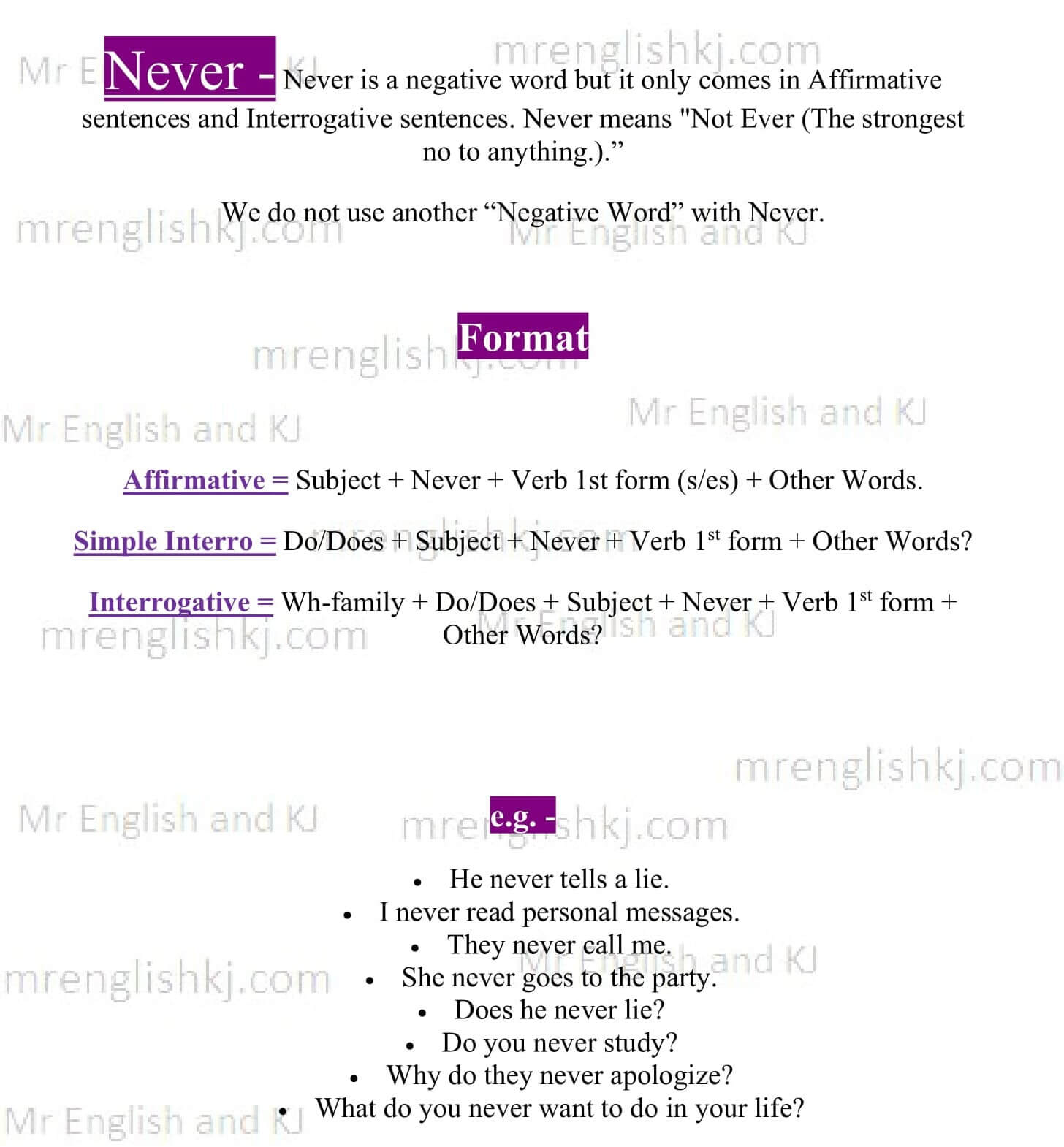
These frequencies often come in sentences = usually, sometimes, never, daily, regularly, often; every year/month/day, every weekend/Summer/Winter, every morning/night; once in a week/month/year, always, fortnightly, hourly, annually, quarterly, constantly, frequently, generally, rarely, occasionally, normally, sometimes, seldom, ever, etc.
e.g. –
- I study every night before I go to sleep.
- We usually travel in our own vehicle.
- He always enjoys a holiday out of the country.
- Do you daily get the bus?
- They never sleep in the afternoon.
- I normally work under pressure.
- She enjoys eating chocolate once a week.
- Some people generally start their morning by drinking coffee.
Instruction, Permission, & Command
We use Present Simple Tense to give or take order, invitation, offer, command, instruction, direction, permission, etc. Sometimes, it comes with the exclamation mark. We do not need to use ‘Subject.’ It is optional to use ‘Subject.’
Note = We usually make “Exclamative Sentence” and “Imperative Sentence” using Present Simple Tense.
Click To Learn More about “Exclamative Sentence” and “Imperative Sentence.“
e.g. –
- Go straight then take a left from there you see a statue. (Imperative Sentence = Go Straight then take a left.)
- Open the door! (Imperative Sentence = Open the door!)
- They call me! (Exclamative Sentence)
- I invite you to join my wedding tomorrow. (Present Simple Tense)
- He feels lucky! (Exclamative Sentence)
- I allow you to talk to anyone. (Present Simple Tense)
- I like food! (Exclamative Sentence)
- Carefully read the question first and then you attentively write down your answer in the box. Don’t write on the question paper! (Imperative Sentence = Read the question first. Don’t write on the question paper!)
Immediate Reactions & Feelings
We often use it with ‘verbs of sense and perception.’ We use Present Simple to talk about feelings and reactions at the moment of speaking. In another word, it is a General Truth.
e.g. –
- Don’t you trust me?
- I don’t like the design, colour, and shape.
- I think, he wears a terrible dress.
- It smells very bad here.
- I hate that movie.
- It seems quite dark here.
Stories & Commentaries
We often use Present Simple to describe a series of actions. These actions happen one after another like a story. Even if we talk about past stories, we can use Present Simple Tense.
I tell you. Why! We can use Present Simple in the Past.
Have you seen any biopic or movies/documentry of history?
If yes then look!
That history already happened in past but still they use Present Words and Sentence because they want to make it lively and fresh, so you feel that it happens right now and take more interest on it. We know “History is Boring,” but the way movie, biopic, documentary, or a story teller explains, we like it. Because they use “Present Words and Sentences. So, we can use “Present Simple Tense” in the past as well to make our speech, talk, or conversation more lively.
e.g. –
- I wake up in the morning to go for a walk. I fresh up myself then I take tea. I tighten my sports shoes and I start running. After 20 minutes, I feel tired. So, I come back home.
(You can talk about your daily routine or any past stories using this tense. Comment down below some of your experiences, our team will check and correct your grammatical mistakes.)
- Movie Name = Dragon: The Bruce Lee Story
- Released Year = 1993

We all have inner demons to fight. We call these demons “fear”, and “hatred”, and “anger”. If you don’t conquer them, then a life of a hundred years is a tragedy. If you do, a life of a single day can be a triumph.
[talking to Bruce Lee, when he was a child]
(All highlighted sentences are in Present Simple Tense, even though Yip Man said these sentences years ago to Bruce Lee when he was a kid, but these sentences are used in Bruce Lee’s biopic later in 1993. The story is about the past and the sentences were said in the past, still, they use Present Simple to make it true and alive.)
Note = You need to be careful using “Present Simple in Past, because when we mix “Present and Past Tense” together in same action, event, or activity, it creates grammatical errors. Better use simultaneously. It means, you only use either “Present Simple Tense” or “Past Tense.” Do not mix “Present and Past” unless you have a proper knowledge of it.
About the commentaries part, I suggest, you should listen sports commentaries like Football or Cricket. The condition is they must be Native English Speaker. You will notice that they use this tense to talk about Past activities. Notice and let us know in the comment section.
Scheduled Future Events: Like Timetables or Plans
When we already planned something that we will do in the future, we use Present Simple. So, by planning the future in the present, we can use Simple Present Tense in the future as well.
e.g. –
- The lesson starts at 10:00 tomorrow instead of 10:30. (Planned Future)
- Dinner is at 9:00. Don’t be late. (Planned Future)
- Students attend class tomorrow. (Planned Future)
- They don’t go back to college until next Monday. (Planned Future)
- My brother arranges a party next month. (Planned Future)
Notice – Have you noticed all these definitions are also General Truth? Present Simple is for the Past, Present, and Future.
Common Questions Answered: Present Indefinite Tense FAQ
Should we use s/es with all verbs in Present Indefinite Tense?
No, we only use s / es with Singular Subject and Affirmative sentence. An affirmative is a sentence where we do not use ‘Not’ or ask any questions. It is a simple answer or reply.
How can we use Present Indefinite in Past Tense?
As I said, it is better to not mix Present and Past Tense together. When you want to talk about Past but you also want to tell it like a Fresh Story, you should use Present Tense and every sentence must be in Present. You cannot mix Past in it. Because mixing two times together is difficult, it is a job for Pros only.
Can we use Present Indefinite for future actions?
Yes. When something is pre-planned or scheduled, we use Present Simple for future events.
Do I need to learn all definitions?
No, this is the best part, when the topic begins, I have described the Present Indefinite Tense definitions using its name. You should remember that or simply focus on General Truth definition.
How do I learn Present Indefinite Tense?
You should follow these steps:
1. Read the whole article on Present Tense.
2. Go through all examples and use them in real life.
3. Try to take all the English tests available.
4. Try to practice by making sentences yourself and reply in comment section. We will correct your mistakes and improve your skills.
Practice the Present Indefinite Tense: Quick Tests for Strong Grammar Skills
Beginner Friendly Exercise With Four Options Each
Practice the tense with these interactive quizzes: It has a balanced touch of basic to advanced questions.
- One: Exercise 1
- Two: Exercise 2
- Three: Exercise 3
- Four: Exercise 4
- Five: Exercise 5
- Six: Exercise 6
- Seven: Exercise 7
- Eight: Exercise 8
- Nine: Exercise 9
- Ten: Exercise 10
Fill In The Blanks Quiz: Learn English With Paragraphs
Slightly more difficult then above quiz, there you will fill the blanks in the paragraphs.
- One: Paragraph Exercise 1
- Two: Paragraph Exercise 2 [The content will be here soon.]
Story Time: Learn and Improve English With Story Tests
The most useful exercises in English, you will learn English by filling interesting story gaps. You will improve not only you English but also vocabulary. [The content will be here soon.]
Advice – Never learn any language using another language. You should learn English in English, not in your native language (mother-tongue). Just like you learned your mother tongue in your own mother tongue. By learning in this way, only makes your English accurate, fluent, and you learn it like a Pro.
Practice in Comment Section: I assure our Team will correct your grammatical mistakes there.