The SAT 2025 Examination Test (Math Module 2nd with Step-By-Step Solutions, Tips and Desmos Tricks
How was your Module 1st? How much score have you made? Please tell us in the comment. The SAT math seems tough without Desmos Calculator but we have solution for this. This test is a practice test of 2025 SAT Math Module Second. Here, you would see questions that were possible to be on 2025 examination. The best parts are:
- solutions of all questions,
- step-by-step explanations,
- how to verify the correct answer,
- description of correct and incorrect options,
- tips and tricks,
- and Desmos Calculator Hacks.
Like the other exams, it has the same format and all the necessary features for you to become a SAT master in math. You just take the Module 2nd exam to practice your skills. The best part is that you practice within the time limit, and there are explanations of answers, tips and tricks to get a perfect score on the SAT. You will find Math easy after this.

ABOUT THE SAT MODULES
The SAT is divided into four modules. There are two categories with each split into two modules. The first category is “Reading and Writing” with two modules. The second category is “Math” with two modules. The one, you will do below is SAT Math 2025 Practice Test Module 2nd.
The first module has questions ranging from easy to difficult, but the second module only contains medium to difficult questions, no easy. If you want to take some other SATs, visit the links below.
- 1st Module of SAT Reading And Writing Practice Tests
- 2nd Module of SAT Reading And Writing Practice Tests
- 1st Module of SAT Math Practice Tests
- 2nd Module of SAT Math Practice Tests
THE SAT MATH MODULE 2ND
The second module of Math in SAT contains four segments: “Algebra,’ ‘Advanced Math,’ ‘Problem-Solving and Data Analysis,’ and ‘Geometry and Trigonometry.” The questions in Module 2nd are from medium to difficult. In a real SAT exam, you must answer 22 questions within 35 minutes. We have provided you with the same in this Practice Test.
Instructions for the SAT Real-Time Exam: Tips Before Taking Tests
- Previous-and-Next: Like in real SAT exam, you can move freely from one question to another, same things you can do here. You select one option and move forward but you realized something, so you came back and change your option. You can do that here and in the real SAT exam too.
- Timer: On the top of the slide, you will see the timer, it starts from 0 and for Module 1st of Math you will get 35 minutes to finish 22 questions. Always try to finish the test before 35 minutes.
- Image: You can click on a graph, table, or other image to expand it and view it in full screen.
- Mobile: You cannot take the real exam on mobile, but our practice exam you can take on mobile phone.
- Calculator: Below the Test, you will see a Desmos calculator and graph for Math. The same, Desmos, will be used in real exams, so learn “How to use Desmos Calculator.”
- Answer All: Even if you do not know the correct answer of a question, still guess it because there is no Negative marking.
- Last Questions: The harder the question, the more marks it will fetch for you. So most likely, you will find later question difficult and more time-consuming, so utilize your time accordingly.
- Tips: This article will help you learn more about the SAT Exams. SAT: EVERYTHING ABOUT THE SAT
Wait for the Desmos Calculator to appear.
SAT MATH PROBLEM SOLUTIONS WITH STEP-BY-STEP EXPLANATION
Do not open the tabs before finishing the practice test above! For your convenience, we have compiled all the solutions and their explanations here. We will also give you some tips and advice to help you understand them better. You’ll see ‘why this answer is correct’ and ‘why this is incorrect.’
Math Solutions and Explanations:
The light red color shows the Question, green shows the Correct answer with step-by-step explanation, red shows the Incorrect one, and blue shows Desmos Tips or Tricks.
1st Question
Question:
If is a solution to the system of equations above, which of the following could be the value of ?
A) -1
B) 0
C) 2
D) 3
🧠 Core Concept (Why substitution is used)
A solution must satisfy both equations at the same time.
So we set them equal.
🧮 Step-by-Step Solution
Subtract from both sides:
Square root on both side or just drop square to right-hand side:
1 square root is 1 – after square root, the value can either be positive or negative
Hence the sign – look below.
So:
In option, we have only given -1, so Option A is correct.
Choice B is incorrect. If , then , but .
Choice C is incorrect. If , then , but .
Choice D is incorrect. If , then , but .
🧮 DESMOS CHECK
1. Enter:
y = x + 1
y = x^2 + x
2. Desmos Graph shows: Intersections at x = −1 and x = 1
2nd Question
Question:
The given equation relates the distinct positive numbers , , and . Which equation correctly expresses in terms of and ?
A)
B)
C)
D)
1️⃣ What the Question Is Asking
~ “Express in terms of and ” means:
~ Isolate j completely
~ The final equation must look like:
2️⃣ Formula / Rule Used
Solving a Linear Equation for a Variable
To isolate a variable:
~ Undo addition / subtraction first
~ Undo multiplication / division last
~ Whatever you do to one side, you must do to the other
3️⃣ Step-by-Step Solution
Start with:
Since is multiplied by 8, divide both sides by 8:
Simplify:
✅ Correct Answer: Option D
❌
~ Only was divided by 8
~ Division must apply to the entire right-hand expression
❌
~ Same mistake: divided only one term
~ This breaks algebraic balance
❌
~ Multiplied instead of divided
~ Does the exact opposite of isolating
5️⃣ Desmos ACTUAL Trick
1. Type: 8j = k + 15m
~ Desmos will ask you to input values of j, k, and, m using a Slider.
~ So you have two choice: Either give all value 1 or
~ Replace j to y, k to a, and m to x. This way Desmos will only ask for you to input value of a using a slider.
2. Type Options one-by-one from 2nd line.
~ Replace j, k, and m if you did it on Step 1.
3. Observe:
Notice that Question equation and Option D follows same line, they are on each other. That is your correct answer.
3rd Question
Question: A ball is dropped from an initial height of 22 feet and bounces off the ground repeatedly. The function estimates that the maximum height reached after each time the ball hits the ground is 85% of the maximum height reached after the previous time the ball hit the ground. Which equation defines , where is the estimated maximum height of the ball after it has hit the ground times and is a whole number greater than 1 and less than 10?
A)
B)
C)
D)
Understand the Question
~ A ball is dropped from an initial height of 22 feet.
~ Each time it hits the ground, the next maximum height is 85% of the previous height.
~ Which equation defines , where:
= maximum height after the ball hits the ground times
1️⃣ What the Question Is Asking
This describes:
~ A repeated percent decrease
~ Each bounce keeps 85% of the previous height
~ This is an exponential decay model
2️⃣ Formula / Rule Used
Exponential Decay Model
Where:
= initial value (starting height)
= decay factor (percent kept, written as a decimal)
= number of bounces
3️⃣ Step-by-Step Reasoning
Step 1: Identify the initial value
~ Initial height = 22 feet
~ So
Step 2: Convert percent to decimal
~ 85% = 0.85
~ This is the decay factor
Step 3: Write the equation
✅ Correct Answer: Option B
❌
~ Used 22% instead of 85%
~ Confused initial height with decay rate
❌
~ Used 85 as a starting height (wrong units)
~ Still wrong decay factor
❌
~ Correct decay rate, but wrong starting value
~ Initial height is 22, not 85
4th Question
Question: Line 𝑘 is defined by 𝑦 = + 4. Line 𝑗 is parallel to line 𝑘 in the 𝑥𝑦-plane. What is the slope of line 𝑗?
A)
B)
C) 4
D) 17
🧠 Core Concept (Must be known before solving)
~ Parallel lines never intersect
~ Parallel lines have exactly the same slope
~ Only the y-intercept may change
This is a definition, not a trick.
🧮 Step-by-Step Solution
The equation of line is already written in slope–intercept form:
This form is important because:
= slope
= y-intercept
From:
we directly read:
Because line is parallel to line , it must have:
So:
✅ Correct Answer: B)
Option A: ❌
Trap: Student flips the fraction, confusing parallel lines with perpendicular lines.
👉 Flipping happens only for perpendicular lines, not parallel ones.
Option C: 4 ❌
Trap: Student mistakes the y-intercept for the slope.
Option D: 17 ❌
Trap: Student ignores the denominator and assumes slope is just the numerator.
🧮 DESMOS CHECK
1. Enter:
y = (17/7)x + 4
y = (17/7)x – 10
2. The lines never intersect → same slope
✔ Confirmed
5th Question
Question: The solution to the given system of equations is (). What is the value of ?
A) −2
B) 6
C) 12
D) 24
🧠 Core Concept
We must:
~ solve the system
~ then compute twice the x-value
🧮 Step-by-Step Solution
Method 1
Step 1: Rewrite both equations to isolate x
First equation:
(Sign changed when move from one-side to another or just Subtract both side by 3)
Second equation:
(Sign changed when move from one-side to another or just do Addition on both side by 3)
Step 2: Set expressions equal (why this works)
Both equal , so: Equation 1 = Equation 2
Sign changes when move from one-side to another
~ on the right-hand side move to left-hand side, so the positive becomes, negative
~ Left-hand side positive 2 moves to right-hand side and becomes negative -2
Step 3: Solve for y
Step 4: Find x
Substitute into: Choose any equation whether 1 or 2.
Step 5: Compute
If is 6 then what will be its double:
✅ Correct Answer: C) 12
Method 2:
Equation 1:
Equation 2:
Adding Equation 2 to Equation 1, in order to find 2x
✅ Correct Answer: C) 12
Option A (−2) ❌
Trap: Student gives instead of .
Option B (6) ❌
Trap: Student stops after finding .
Option B (6) ❌
Trap: Student stops after finding .
🧮 Desmos Confirmation
1. Open Desmos
2. Enter:
x + 3 = -2y + 5
x – 3 = 2y + 7
3. Check the graph:
~ Shows three intersection (0, -5), (6, -2), and (10, 0)
~ we know (x, y)
~ There are three x given in graph: (x = 0), (x = 6), and (x = 10)
~ but we need double of x
~ means x multiplied by 2
~ there are no options like 0 or 20, so we pick
Intersection at →
6th Question
Question:
What is the solution to the equation above?
A) 0
B) 2
C) 3
D) 5
Understand the Question
What the Question Is Asking
Solve the equation and find the value of that makes both sides equal, keeping in mind domain restrictions.
Important Rules / Concepts
~ Fractions with the same denominator can be combined.
~ Never allow the denominator to be zero.
~ Clearing fractions by multiplying both sides by the LCD avoids mistakes.
Step-by-Step Solution
Step 1: Identify the common denominator
Step 2: Multiply both sides by x+5
You can either multiply both sides with x+5 or notice that there are two sides and what we normally do at this point, is either cross multiply or the value in divide / denominator goes to other side as multiplication.
Step 3: Simplify
Left side: We cut (x + 5) to (x + 5).
Right side:
1 will multiply with (x + 5) and after Minus sign, we cut both x + 5 to (x + 5).
We are left with:
So: Left-hand side and right-hand side are:
Step 4: Solve
Check the Solution
Substitute :
✔ Valid solution.
Correct Answer: Option B
Why Other Options Are Wrong
0 → does not balance both sides
3 → fails when substituted
5 → incorrect algebra result
Common Student Mistakes
❌ Forgetting to multiply every term by the denominator
❌ Cancelling incorrectly
❌ Not checking the solution
Desmos Trick (Actual)
Type: 2(x+1)/(x+5) = 1 – 1/(x+5)
Desmos shows the intersection at x = 2.
7th Question
Question: Ages of 20 Students Enrolled in a College Class
| Age | Frequency |
|---|---|
| 18 | 6 |
| 19 | 5 |
| 20 | 4 |
| 21 | 2 |
| 22 | 1 |
| 23 | 1 |
| 30 | 1 |
The table above shows the distribution of ages of the 20 students enrolled in a college class. Which of the following gives the correct order of the mean, median, and mode of the ages?
A) mode < median < mean
B) mode < mean < median
C) median < mode < mean
D) mean < mode < median
Understanding the Question
You are given the ages of 20 students and how often each age appears.
You are asked to determine the correct order of:
Mean
Median
Mode
This is a data interpretation + statistics question.
Important Definitions / Rules
Mean = average = (sum of all values) ÷ (number of values)
Median = middle value when data is ordered
Mode = most frequent value
⚠️ In right-skewed data (a few large values pulling the data right):
Step-by-Step Solution
Step 1: Identify the Mode
From the frequency table:
| Age | Frequency |
|---|---|
| 18 | 6 |
| 19 | 5 |
| 20 | 4 |
| 21 | 2 |
| 22 | 1 |
| 23 | 1 |
| 30 | 1 |
Highest frequency = 6
Mode = 18
Step 2: Find the Median
There are 20 students, so the median is the average of the 10th and 11th values.
Cumulative count:
Ages 18 → positions 1–6
Ages 19 → positions 7–11
So:
10th value = 19
11th value = 19
👉 Median = 19
Step 3: Reason About the Mean
There is a large outlier (age 30) that pulls the average upward.
So:
Final Order
✅ Correct Answer: mode < median < mean
Why Other Options Are Wrong
mean < mode < median ❌
Mean is the largest due to skew.
mode < mean < median ❌
Mean is larger than median here, not smaller.
median < mode < mean ❌
Mode (18) is smaller than median (19).
8th Question
Question: A bus traveled on the highway and on local roads to complete a trip of 160 miles. The trip took 4 hours. The bus traveled at an average speed of 55 miles per hour (mph) on the highway and an average speed of 25 mph on local roads. If is the time, in hours, the bus traveled on the highway and is the time, in hours, it traveled on local roads, which system of equations represents this situation?
A)
B)
C)
D)
Understand the Question
A bus traveled a total of 160 miles in 4 hours.
~ Speed on highway = 55 mph
~ Speed on local roads = 25 mph
~ = time (hours) on highway
~ = time (hours) on local roads
Which system of equations represents this situation?
🧠 Core Concept (Why two equations are needed)
This is a rate × time = distance problem.
We always build:
1. Distance equation
2. Time equation
🧮 Step-by-Step Explanation
Step 1: Build the distance equation (this is the key)
Distance = (speed)(time)
~ Highway distance =
~ Local road distance =
Total distance:
This equation must equal miles, not hours.
Step 2: Build the time equation
The total time spent traveling is 4 hours.
~ Only Option B matches both correct equations.
✅ Correct Answer: B
Option A ❌
~ Uses distance equation = 4 (wrong units)
~ Uses time equation = 160 (wrong units)
Trap: Student swaps miles and hours.
Option C ❌
Trap: Student swaps highway and local speeds.
Option D ❌
Trap: Student uses correct structure but wrong speed placement.
9th Question
Question: For a snowstorm in a certain town, the minimum rate of snowfall recorded was 0.6 inches per hour, and the maximum rate of snowfall recorded was 1.8 inches per hour. Which inequality is true for all values of , where represents a rate of snowfall, in inches per hour, recorded for this snowstorm?
A)
B)
C)
D)
🧠 Core Concept
When a value is between a minimum and a maximum, we use a compound inequality:
🧮 Step-by-Step Solution
The snowfall rate:
~ Cannot be less than 0.6
~ Cannot be greater than 1.8
So all valid values of satisfy:
✅ Correct Answer: B)
Option A: s ≥ 2.4 ❌
Trap: Student incorrectly adds the min and max.
Option C: s ≥ 1.8 ❌
Trap: Student uses only the maximum and ignores the minimum.
Option D: 0 ≤ s ≤ 0.60 ❌
Trap: Student assumes snowfall starts at zero and stops at minimum.
🧮 DESMOS CHECK
Type: 0.6 ≤ s ≤ 1.8
This shades exactly the valid region.
✔ Confirmed
10th Question
Question: Circle has a radius of 6 millimeters (mm). Circle has an area of . What is the total area, in , of circles and ?
A)
B)
C)
D)
Understanding the Question
You are given two circles:
Circle B → radius is known
Circle D → area is already given
You are asked to find the total area of both circles.
Important Formula / Rule
The area of a circle is:
Step-by-Step Solution
Step 1: Area of Circle B
Radius of Circle B:
Apply the area formula:
Step 2: Area of Circle D
Given directly:
Step 3: Total Area
Correct Answer: Option D
Why Other Options Are Incorrect
36π ❌ Only area of circle B
64π ❌ Only area of circle D
78π ❌ Incorrect addition
Common Student Mistakes
Ignoring the given area of one circle
Forgetting to square the radius
Adding radii instead of areas
Use DESMOS as a calculator only.
11th Question
Question:
The functions and are defined by the equations shown. Which expression is equivalent to ?
A)
B)
C)
D)
Important Rules
~ Use distributive property (FOIL).
~ Multiply every term carefully.
~ Combine like terms.
Step-by-Step Solution
Distribute:
Step 1: Multiply each pair
Step 2: Combine like terms
Final expression:
Correct Answer: Option D
Why Other Options Are Wrong
A → missing the middle -term
B → incorrect coefficient of
C → sign error on the linear term
Common Student Mistakes
❌ Forgetting one distributive multiplication
❌ Combining unlike terms
❌ Sign error
Desmos Trick
1. Type the question equation: replace j to x.
~ First line: k(x) = 3/5 x + 7/6
~ Second line: r(x) = 6x – 5
2. Type options from 3rd line one-by-one: 18x^2 /5 + 4x – 35/6
3. Observe the graph: Option D and question line on graph.
~ The intersect points of both k(x) and r(x) matches exactly to Option D.
~ Focus on Intersect points.
OR
If it is difficult for you then do one simple thing.
Consider any value of j like j = 2.
Now, all you need to do is to type:
Question equations in multiply form like asked and options but filling value j.
The Option D output will be the same as questions.
12th Question
Question: A model predicts that a certain animal weighed 241 pounds when it was born and that the animal gained 3 pounds per day in its first year of life. This model is defined by an equation in the form , where is the predicted weight, in pounds, of the animal days after it was born, and and are constants. What is the value of ?
[Type-Based Answer: In the final exam, you will type the answer rather than choose from options.]
Understand the Question
A model predicts:
~ Animal weighed 241 pounds at birth
~ Gained 3 pounds per day
The model is:
where:
= weight after days
are constants
What is the value of ?
🧠 Core Concept (Critical)
In:
= starting value (when days)
= rate of change
🧮 Step-by-Step Solution
Since, we were not given “any time “how many days” in question, so we focus on:
“At birth” means:
Substitute into the model:
The problem states:
So:
✅ Correct Answer: 241
❌ 244
Mistake: Student adds one day of growth immediately:
They forget that represents before any growth occurs.
❌ 3
Mistake: Student confuses rate of change with starting value .
❌ 0
Mistake: Student assumes all models start at zero.
🧮 DESMOS CONFIRMATION
1. Enter: f(x) = 241 + 3x
2. Check: x = 0 → f(0) = 241
✔ Confirms
13th Question
Question:
Which of the following expressions is equivalent to the expression above?
A)
B)
C)
D)
Important Rules
Step-by-Step Solution
Split the cube root:
Simplify each part:
Correct Answer: Option B
Why Other Options Are Wrong
y² → ignores the term
y³ → wrong exponent
xy³ → incorrect root simplification
Common Student Mistakes
❌ Dividing exponents incorrectly
❌ Forgetting variables under the radical
❌ Mixing square-root and cube-root rules
Desmos Trick
Use Desmos as a calculator. It would be better you solve it like above, but if you want to use Desmos then assign values to x and y.
x = 2.
y = 2.
You can choose any values, now all you need to do is to find output of question and options to figure it which matches exactly.
14th Question
Question: Two customers purchased the same kind of bread and eggs at a store. The first customer paid 12.45 dollars for 1 loaf of bread and 2 dozen eggs. The second customer paid 19.42 dollars for 4 loaves of bread and 1 dozen eggs. What is the cost, in dollars, of 1 dozen eggs?
A) 4.34
B) 4.15
C) 3.88
D) 3.77
Understand the Question
Two customers purchased the same kind of bread and eggs.
~ Customer 1:
1 loaf of bread + 2 dozen eggs = $12.45
~ Customer 2:
4 loaves of bread + 1 dozen eggs = $19.42
What is the cost of 1 dozen eggs?
🧠 Concept Used (Why this is a system)
We are buying two items (bread and eggs), so we must use:
~ two variables
~ two equations
Let:
= cost of 1 dozen eggs
= cost of 1 loaf of bread
🧮 Step-by-Step Solution
Step 1: Write equations from the word problem
Customer 1:
Customer 2:
Step 2: Solve the system (elimination method)
To eliminate , multiply the second equation by 2:
Now subtract the first equation:
Step 3: Substitute to find eggs cost
Substitute into:
✅ Correct Answer: A) 4.34
Option B: 4.15 ❌
Trap: Student divides incorrectly when solving .
Option C: 3.88 ❌
Trap: Student mistakenly reports bread price instead of egg price.
Option D: 3.77 ❌
Trap: Student stops after finding and forgets question asks for eggs.
🧮 DESMOS METHOD
1. Enter:
b + 2e = 12.45
4b + e = 19.42
2. Use intersection
3. Read value of
✔ Confirms
15th Question
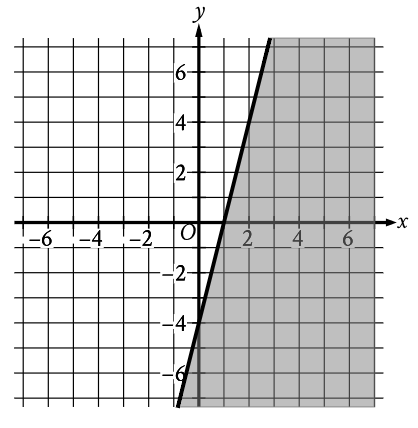
Question: The shaded region shown represents the solutions to an inequality. Which ordered pair (, ) is a solution to this inequality?
A) (6, −2)
B) (1, 4)
C) (−2, 5)
D) (−5, −6)
🧠 Concept Used
A solution must lie inside the shaded area
~ Right side of the line = valid
~ Left side = invalid
~ Inequality solutions are regions, not single values, so focus where both x and y touch
🧮 Step-by-Step Visual Reasoning
From the graph:
~ The shaded region is to the right of the line
~ The line slopes upward
We should not focus on individual x or y. We should focus on the point they both touch.
Check each option:
(6, −2) ✅
x = 6 → far to the right
→ slightly below the x-axis
When plotted:
~ This point is clearly inside the shaded area
✔ This satisfies the inequality
Option B: (1,4) ❌
→ close to the y-axis
~ This point lies to the left of the boundary line
Even though is positive:
~ The point is outside the shaded region
✘ Not a solution
Trap: Students assume “positive y” means shaded — wrong.
Option C: (−2,5) ❌
~ Negative x
~ Upper-left quadrant
This point is entirely on the unshaded side
✘ Not a solution
Trap: Students think “higher y = valid” — incorrect for inequalities.
Option D: (−5,−6) ❌
~ Far left
~ Far down
Clearly outside the shaded region
✘ Not a solution
🧮 (Confirmation, Not Replacement) — Desmos Check
In Desmos:
1. Plot the boundary line
2. Plot point
3. The point appears inside the shaded half-plane
✔ Confirms visual reasoning
✘ Desmos is not the main reasoning, only confirmation\
16th Question
Question: The measure of angle is . What is the measure, in radians, of angle ?
A)
B)
C)
D)
Understanding the Question
You are asked to convert degrees to radians.
Important Conversion Rule
Step-by-Step Solution
Step 1: Substitute the Angle
Step 2: Simplify
Correct Answer: Option B
Both are the same.
Why Other Options Are Incorrect
π/6 ❌ Equals 30°
2π/3 ❌ Equals 120°
π ❌ Equals 180°
Common Student Mistakes
Cancelling π incorrectly
Forgetting to divide by 180
Confusing radians with degrees
Use DESMOS as a calculator.
17th Question
Question:
One of the two equations in a system of linear equations is given. The system has no solution.
Which equation could be the second equation?
A)
B)
C)
D)
🔑 What “NO SOLUTION” Means (Applied, Not Theory)
A system has no solution when:
~ The two lines are parallel
~ Same slope
~ Different intercepts, so they never intersect
This condition will guide every step below.
🧮 Rewrite the given equation in comparable form
Given (The most important step to solve it):
Divide every term by 3 or move 3 to right-hand side into divide position:
Now this equation is in a clean form where we can clearly see:
~ Slope = 12
~ Intercept = −15
This rewritten form is the reference equation.
✅ OPTION B — CORRECT ANSWER
Step 1: Rewrite Option B
Multiply both sides by 3: or just move 3 to right-hand side like this (4y multiply by 3)
Step 2: Compare with the given equation
Given:
Option B:
Now compare carefully:
| Feature | Given Equation | Option B |
|---|---|---|
| Slope | 12 | 12 |
| Intercept | −15 | 0 |
✔ Same slope
✔ Different intercepts
Final Conclusion for Option B
~ Same slope → parallel lines
~ Different intercepts → never meet
✅ No solution
✅ Option B is correct
❌ OPTION A — THE REAL TRAP
Why Option A FEELS Correct to Many Students
Students often think:
~ “The system has no solution”
~ “So the equations must be different”
~ “This equation looks simpler and different”
~ “Maybe any different equation works”
That thinking is dangerous.
Rewrite Option A Properly
Compare with: Simplify form of 3x = 36y – 45
Now compare slopes:
~ Given equation slope = 12
~ Option A slope = 4
Since the slopes are different, the lines are not parallel.
What That Means
~ Different slopes → lines must intersect
~ Intersecting lines → one solution
But the question says: The system has NO solution
So Option A cannot be correct.
❌ Option A is a trap caused by ignoring slopes
❌ OPTION C
This is identical to the given equation.
That means:
~ Same line
~ Infinite intersection points
This produces infinitely many solutions, not “no solution.”
❌ Incorrect
❌ OPTION D
Multiply both sides by 3:
This is exactly the original equation given in the question.
Again:
~ Same line
~ Infinite solutions
❌ Incorrect
🧮 DESMOS CALCULATOR — SAT-REALISTIC CONFIRMATION
Step-by-Step in Desmos
1. Open Desmos
2. In Expression Line 1, type: x = 12y – 15
3. In Expression Line 2, type: x = 12y (Simplify all options then type one by one to check)
4. Observe the graph:
~ Two straight lines
~ Same direction
~ Never intersect
5. Zoom in and out using the zoom controls
6. No intersection point appears
✔ Confirms no solution
18th Question
Question: A data set of 27 different numbers has a mean of 33 and a median of 33. A new data set is created by adding 7 to each number in the original data set that is greater than the median and subtracting 7 from each number in the original data set that is less than the median. Which of the following measures does NOT have the same value in both the original and new data sets?
A) Median
B) Mean
C) Sum of the numbers
D) Standard deviation
Understanding the Question
There are 27 different numbers
Mean = 33
Median = 33
A transformation is applied:
~ Numbers greater than the median → add 7
~ Numbers less than the median → subtract 7
~ The median itself (33) is unchanged
We must determine which statistical measure changes after this transformation.
Key Rules / Concepts
Median → middle value (position-based)
Mean → depends on the total sum
Sum → total of all values
Standard deviation → measures spread (distance from mean)
Step-by-Step Reasoning
New and Old Changes or Not
Median
~ There are 27 numbers → the median is the 14th value
~ That value is 33
~ The transformation does not change the median itself
✅ Median stays the same
Mean & Sum: 13 + 1 + 13 = 27
~ There are 13 numbers below 33 → each gets –7
~ There are 13 numbers above 33 → each gets +7
~ Net change in sum:
✅ Sum stays the same
✅ Mean stays the same
Standard Deviation
~ Values move farther away from the mean
~ Spread increases
❌ Standard deviation changes
Correct Answer: Option D
Why Other Options Are Incorrect
Median ❌ unchanged
Mean ❌ unchanged
Sum ❌ unchanged
Common Student Trap
Thinking “numbers changed, so mean must change” — ignoring symmetry.
19th Question
Question: Which of the following expressions is equivalent to ?
A)
B)
C)
D)
Question Explanation
We are given the expression:
We are asked to find which option is equivalent to this expression.
This is a trigonometric identity recognition question, not a numerical approximation question.
Important Formula / Rule Used
🔑 Sine Addition Identity
This identity is exactly in the same structure as the given expression.
Option C
✅ CORRECT
Why this works:
Use the complementary-angle identity:
Substitute into the original expression:
Which becomes:
✔ Exact match
Final Answer
✅ Correct Option: C
Option A❌ Incorrect
Why:
This doubles only one product term and ignores the second term entirely.
The identity does not allow combining terms this way.
Common student mistake:
Thinking “two similar terms” exist when they do not.
Option B
❌ Incorrect
Why:
The original expression involves products, not sums.
You cannot convert multiplication into addition in trig identities.
Student trap:
Confusing distributive property with trigonometric identities.
Option D
❌ Incorrect (VERY subtle error)
Why it looks tempting:
Because
But here’s the mistake:
That is not equal to:
Since:
Student mistake pattern:
Replacing only one angle correctly, but failing to check whether both squared terms represent different values.
20th Question
Question:
2(8x) + 4(7y) = 12
-2(8x) + 4(7y) = 12
The solution to the given system of equations is (x, y). What is the value of 8x + 7y?
[Type-Based Answer: In the final exam, you will type the answer rather than choose from options.]
3 is correct. You must be thinking, this explanation is too big, but fear not, we have explained every possible ways to solve this equation. Take it educational that clears your concepts.
🧮 Step-by-Step Correct Solution
2(8x) + 4(7y) = 12 ……….. Equation 1
-2(8x) + 4(7y) = 12 ………. Equation 2
There are two Methods:
Method 1: (With Simplification)
Step 1: Simplify both equations carefully
First equation:
2(8x) + 4(7y) = 12
16x + 28y = 12 (Equation 1)
Second equation:
−2(8x) + 4(7y) = 12
−16x + 28y = 12 (Equation 2)
Step 2: Eliminate a variable
Subtract Equation 2 from Equation 1:
Equation 1 – Equation 2
(16x + 28y) − (−16x + 28y) = 12 − 12
16x + 28y +16x – 28y = 0
16x + 16x + 28y – 28y = 0
32x = 0
x = 0 / 32
x = 0
Method 2: (Without Simplification)
Just use the whole equations from start and Subtract Equation 2 from Equation 1:
2(8x) + 4(7y) = 12 ……….. Equation 1
-2(8x) + 4(7y) = 12 ………. Equation 2
[2(8x) + 4(7y) = 12] – [-2(8x) + 4(7y) = 12]
(16x + 28y) – (-16x + 28y) = 12 – 12
16x + 28y + 16x – 28y = 0
16x + 16x + 28y – 28y = 0
32x = 0
x = 0 / 32
x = 0.
But What if – instead of Subtracting, we do Addition:
2(8x) + 4(7y) = 12 ……….. Equation 1
-2(8x) + 4(7y) = 12 ………. Equation 2
[2(8x) + 4(7y) = 12] + [-2(8x) + 4(7y) = 12]
(16x + 28y) + (-16x + 28y) = 12 + 12
16x + 28y – 16x + 28y = 24
16x – 16x + 28y + 28y = 24
56y = 24
y = 24 / 56
y = 3 / 7
(The same Addition is used in Method 1 also.)
Now, suppose, you only found one whether x or y. All you need to do is to put value in any one equation.
Let’s pick Equation 1 to fill x-value to find out y:
x = 0
2(8x) + 4(7y) = 12 ……….. Equation 1
2(8 . 0) + 4(7y) = 12
2(0) + 28y = 12
28y = 12
y = 12 / 28
y = 3 / 7
Let’s pick Equation 2 to fill y-value to find out x:
y = 3 / 7
-2(8x) + 4(7y) = 12 ………. Equation 2
We know (x = 0) and (y = 3 / 7).
Final Step: Compute 8x + 7y
✅ Final Answer: 3
🧮 DESMOS METHOD (FAST & SAFE)
1. Open Desmos
2. Expression Line 1: 16x + 28y = 12
3. Expression Line 2: -16x + 28y = 12
4. Click the intersection point → Desmos shows (x, y): (0, 3/7)
5. New Expression Line: 8x + 7y
6. Desmos evaluates it as: 3
21th Question
Question: A grove has 6 rows of birch trees and 5 rows of maple trees. Each row of birch trees has 8 trees 20 feet or taller and 6 trees shorter than 20 feet. Each row of maple trees has 9 trees 20 feet or taller and 7 trees shorter than 20 feet. A tree from one of these rows will be selected at random. What is the probability of selecting a maple tree, given that the tree is 20 feet or taller?
A)
B)
C)
D)
Understanding the Question
We are asked: Probability that a randomly selected tall tree (≥ 20 ft) is a maple tree
This is a conditional probability.
Key Formula of Probability
Step-by-Step Solution
Birch Trees: b
6 rows × 8 tall trees = 48 tall birch trees
Maple Trees: m
5 rows × 9 tall trees = 45 tall maple trees
Total Tall Trees: b + m
Conditional Probability of Maple Trees:
Simplify:
Correct Answer: Option C
Why Other Options Are Incorrect
9/164 ❌ uses total trees instead of tall trees
3/10 ❌ random guess
9/17 ❌ incorrect simplification
Common Student Mistake
Using all trees instead of only tall trees in the denominator.
DESMOS Tricks
1. Type: 45/(48+45)
2. Type Options one-by-one in different lines:
15/31
3. Output: 0.4838…
Option C will be the same as the question equation.
22th Question
Question: A window repair specialist charges $220 for the first two hours of repair plus an hourly fee for each additional hour. The total cost for 5 hours of repair is $400. Which function f gives the total cost, in dollars, for x hours of repair, where x ≥ 2?
A)
B)
C)
D)
Option A is correct.
🧮 STEP-BY-STEP SOLUTION
The question gives three critical pieces of information:
1. $220 covers the first 2 hours — this is a fixed starting cost
2. : Any time after 2 hours is charged per hour – this is a variable cost
3. 5 total hours cost $400
The phrase “first two hours” and the condition are the key signals that this is not a simple hourly rate from zero.
Step 1: Identify the fixed cost
The specialist charges:
This amount is charged no matter what, as long as .
So $220 must appear as a constant term in the function.
Immediately, this eliminates any option without +220.
❌ Eliminate:
~ Option A
~ Option C
Step 2: Use the given total cost to find the hourly rate
We are told:
~ Total hours = 5
~ Total cost = $400
Out of these 5 hours:
~ First 2 hours cost $220
~ Remaining hours (x) = hours
So the cost of the additional 3 hours is:
Now find the hourly fee: (Divided by 3 hours)
So the additional hourly charge is:
Step 3: Build the function correctly
For :
~ Fixed cost = 220
~ Hourly cost applies to all x hours, but the constant already accounts for the first 2 hours
So the total cost function must be:
✅ Correct Answer: B)
Option A: f(x) = 60x + 100 ❌
Why students choose this:
~ They subtract incorrectly:
~ They try to “adjust” the constant without logic
Why it fails:
At :
But at :
This works only accidentally and does not represent the pricing structure correctly.
SAT checks modeling, not coincidence.
❌ Rejected
Option C: f(x) = 80x ❌
Why students choose this:
~ They divide total cost by total hours:
This assumes:
~ No fixed cost
~ Same rate from hour 1
That directly contradicts the problem statement.
❌ Rejected
Option D: f(x) = 80x + 220 ❌
Why students choose this:
They combine both mistakes:
~ Wrong hourly rate
~ Double-counting the fixed fee
Check at :
❌ Way too large
🧮 DESMOS CALCULATOR — SAT-CONFIRMATION METHOD
Step-by-Step
1. Open Desmos
2. In Expression Line 1, type: f(x) = 60x + 220
3. In Expression Line 2, type: x = 5
4. Use the Table icon:
~ Enter x = 5
~ Observe output aligns with the pricing structure
5. Compare with other options by replacing the equation
Only Option B models:
~ Fixed first cost
~ Correct additional hourly rate
~ Valid for
✅ FINAL ANSWER
Did you try all the features and get comfortable using them? You should work on using the calculator and seeing references and directions. So be prepared for everything before taking the final SAT exam. The explanation of answers makes easier to learn and progress. You must try to work on your speed and spend less time on the beginning and more on the later questions. This is the SAT 2025 Practice Test of Math Module 2nd.
There are more tests available:
- SAT 2025 Test (Math Module 1st)
- SAT Test 3rd (Math Module 1st)
- SAT Test 6th (Reading and Writing Module 2nd)
The best way to become a master in Math is to find the correct answer and understand why other options are incorrect. I wish you luck in your bright career.