
The SAT Real Examination Like Test of 2024 (Math Module 1st with All 4 Options Solutions & Desmos Steps
There are tricks to solve SAT math quickly with or without Desmos Calculator that you will learn after this. This test is a practice test of 2024 SAT Math Module First. Here, you would see questions that were possible to be on 2024 examination. The best parts are:
- solutions of all questions,
- step-by-step explanations,
- how to verify the correct answer,
- description of correct and incorrect options,
- tips and tricks,
- and Desmos Calculator Hacks.
Like the other exams, it has the same format and all the necessary features for you to become a SAT master in math. You just take the Module 1st exam to practice your skills. The best part is that you practice within the time limit, and there are explanations of answers, tips and tricks to get a perfect score on the SAT. You will find Math easy after this.
ABOUT THE SAT MODULES
The SAT is divided into four modules. There are two categories with each split into two modules. The first category is “Reading and Writing” with two modules. The second category is “Math” with two modules. The one, you will do below is SAT Math 2024 Practice Test Module 1st.
The first module has questions ranging from easy to difficult, but the second module only contains difficult questions. If you want to take some other SATs, visit the links below.
- 1st Module of SAT Reading And Writing Practice Tests
- 2nd Module of SAT Reading And Writing Practice Tests
- 1st Module of SAT Math Practice Tests
- 2nd Module of SAT Math Practice Tests
THE SAT MATH MODULE 1ST
The first module of Math in SAT contains four segments: “Algebra,’ ‘Advanced Math,’ ‘Problem-Solving and Data Analysis,’ and ‘Geometry and Trigonometry.” The questions in Module 1st are from easy to difficult. In a real SAT exam, you must answer 22 questions within 35 minutes. We have provided you with the same in this Practice Test.
Instructions for the SAT Real-Time Exam: Tips Before Taking Tests
- Previous-and-Next: Like in real SAT exam, you can move freely from one question to another, same things you can do here. You select one option and move forward but you realized something, so you came back and change your option. You can do that here and in the real SAT exam too.
- Timer: On the top of the slide, you will see the timer, it starts from 0 and for Module 1st of Math you will get 35 minutes to finish 22 questions. Always try to finish the test before 35 minutes.
- Image: You can click on a graph, table, or other image to expand it and view it in full screen.
- Mobile: You cannot take the real exam on mobile, but our practice exam you can take on mobile phone.
- Calculator: Below the Test, you will see a Desmos calculator and graph for Math. The same, Desmos, will be used in real exams, so learn “How to use Desmos Calculator.”
- Answer All: Even if you do not know the correct answer of a question, still guess it because there is no Negative marking.
- Last Questions: The harder the question, the more marks it will fetch for you. So most likely, you will find later question difficult and more time-consuming, so utilize your time accordingly.
- Tips: This article will help you learn more about the SAT Exams. SAT: EVERYTHING ABOUT THE SAT
Wait for the Desmos Calculator to appear.
SAT MATH PROBLEM SOLUTIONS WITH STEP-BY-STEP EXPLANATION
Do not open the tabs before finishing the practice test above! For your convenience, we have compiled all the solutions and their explanations here. We will also give you some tips and advice to help you understand them better. You’ll see ‘why this answer is correct’ and ‘why this is incorrect.’
Math Solutions and Explanations:
The light red color shows the Question, green shows the Correct answer with step-by-step explanation, red shows the Incorrect one, and blue shows Desmos Tips or Tricks.
1st Question
Question: If , what is the value of ?
[Type-Based Answer: In the final exam, you will type the answer rather than choose from options.]
17 is correct.
Step 1: Solve for
We have given:
(6 divided by 2)
Step 2: Substitute into 6x – 1
Now we know x is 3, let’s solve.
6(3) – 1
18 – 1
17.
✅ Final Answer: 17.
🧮 DESMOS METHOD (VERY PRECISE)
Method 1: Table (Fastest)
1. Open Desmos
2. In Expression Line: 2x + 3 = 9
3. Click solution → Desmos shows: x = 3
4. New line: 6x – 1
5. Desmos shows: 17
✅ Confirmed
2nd Question
Question: The function is defined by . For what value of does ?
A) 8
B) 9
C) 64
D) 80
✅ Correct Answer: B) 9
🧮 Correct Solution — Step by Step
We are told:
and
That means:
[For what value of does ? Take it as “Makes / Gives.” For what value of makes .]
Step 1: Isolate x
Divide both sides by 8 or simple solve it like this:
Step 2: Compute
✔ So, the correct value of is 9.
Choice A is incorrect and may result from conceptual or calculation errors.
Choice C is incorrect and may result from conceptual or calculation errors.
Choice D is incorrect and may result from conceptual or calculation errors.
🧮 DESMOS CALCULATOR — SAT-REALISTIC METHOD
Method 1: Graph Intersection (Most Visual)
1. Open Desmos
2. In Expression Line 1, type: y = 8x
3. In Expression Line 2, type: y = 72
4. Click the intersection point
Desmos displays: (9, 72)
✔ x-value = 9
Method 2: Table (Fastest on SAT)
1. Click the Table icon next to y = 8x
2. Try values from options:
x = 8 → y = 64
x = 9 → y = 72 ✅
✔ Confirmed
✅ FINAL ANSWER: 9
3rd Question
Question: A printer produces posters at a constant rate of 42 posters per minute. At what rate, in posters per hour, does the printer produce the posters?
A) 2520
B) 102
C) 18
D) 1.42
✅ Understand the QUESTION
Unit Conversion (Rate Problem)
Given:
~ Printer rate = 42 posters per minute
~ Asked: posters per hour
🧠 Step-by-Step Solution
Step 1: Identify the conversion factor
Step 2: Multiply the rate
2520 ✅ Option A
102 ❌
Addition instead of multiplication.
18 ❌
Subtract instead of multiplication.
1.42 ❌
Division instead of multiplication.
🧮 Desmos Check
1. Type: 42*60
2. Output: 2520
4th Question
Question:
What is the positive solution to the given equation?
A) 40
B) 50
C) 9
D) -9
🧠 Step-by-Step Mathematical Solution
We are given an equation involving absolute value:
Step 1: Isolate the absolute value
Divide both sides by 5 because it is multiplying |x|:
Step 2: Interpret absolute value
The equation |x| = 9 means:
Step 3: Apply the question condition
The question asks for the positive solution only.
So we select:
40 ❌
A student choosing 40 likely:
~ Multiplied 5 × 9 incorrectly
~ Subtract 45 – 5 incorrectly
~ Or misunderstood absolute value as multiplication
No step leads to 40.
50 ❌
This comes from:
Guessing instead of solving.
-9 ❌
This is a solution, but:
The question explicitly asks for the positive solution
🧮 Desmos Calculator (Correct Usage)
1. Open Desmos
2. Type: 5|x| = 45
3. Desmos shows two intersection points: x = 9 and x = -9
4. Select the positive x-value
✅ Final answer confirmed: 9
5th Question
Question: Triangles and are congruent, where , , and correspond to , , and , respectively. The measure of angle is and the measure of angle is . What is the measure of angle ?
A)
B)
C)
D)
✅ Understand the QUESTION
Congruent Triangles & Corresponding Angles
Given:
~ Triangles EFG and JKL are congruent
~ Correspondence is stated clearly:
Asked:
What is the measure of ?
🧠 Key Geometry Rule (Very Important)
Congruent triangles have equal corresponding angles and sides.
Since:
It directly means:
✏️ Step-by-Step Solution
No calculation needed beyond recognizing correspondence.
✅ Correct: Option B
20° ❌
That is , not .
SAT trap: mixing up corresponding vertices.
135° ❌
This would be the third angle if added incorrectly.
SAT trap: unnecessary angle sum calculation.
160° ❌
Impossible for a triangle angle here.
📌 Student Reminder
Always match letters first in congruent triangle problems before doing any math.
6th Question
Question: Which expression is equivalent to ?
A)
B)
C)
D)
🧠 Step-by-Step Mathematical Solution
Step 1: Factor out the greatest common factor (GCF)
Both terms contain x:
This is the simplified equivalent expression.
✅ Option C.
VERIFICATION:
Expand again:
A ❌
Expands to:
Not equal to the original expression.
B ❌
Introduces x³, which never appeared originally.
SAT trap: unnecessary higher powers.
D ❌
Factor 34 does not match any coefficient in the original expression.
🧮 Desmos Verification
1. Type: 23x^2 + 2x^2 + 9x
2. Type all options one-by-one
3. You will notice that the Option C line in graph will be on the Question expression.
~ Both same will be same. That is your correct option in graph.
7th Question
Question: A store sells two different-sized containers of a certain Greek yogurt. The store’s sales of this Greek yogurt totaled 1,277.94 dollars last month. The equation represents this situation, where is the number of smaller containers sold and is the number of larger containers sold. According to the equation, which of the following represents the price, in dollars, of each smaller container?
A) 5.48
B) 7.30y
C) 7.30
D) 5.48x
Choice A is correct.
🧮 Step-by-Step Solution
This equation represents total revenue, built using the structure:
Look carefully at the term involving x, because:
~ x represents the number of smaller containers
~ The coefficient multiplying represents the price per smaller container
From the equation:
~ 5.48x: revenue from smaller containers
~ 7.30y: revenue from larger containers
So the price per smaller container is the coefficient of .
✅ Correct Answer: A) 5.48
Option B: 7.30y ❌
Trap: Student sees the larger price but forgets the question asks for smaller containers.
Option C: 7.30 ❌
Trap: Student identifies a price but for the wrong container size.
Option D: 5.48x ❌
Trap: Student includes the variable.
This represents total revenue from smaller containers, not the price per container.
🧮 DESMOS CONFIRMATION
1. Open Desmos
2. Type: 5.48x + 7.30y = 1277.94
3. Observe coefficients: Coefficient of → price per smaller container
✔ Confirmed
8th Question
Question: What is the area, in square inches, of a rectangle with a length of 7 inches and a width of 6 inches?
A) 13
B) 20
C) 42
D) 84
✅ Understand the QUESTION
Area of a Rectangle
Given:
~ Length = 7 inches
~ Width = 6 inches
Asked:
Area in square inches
🧠 Geometry Formula
✏️ Calculation
✅ Correct Answer: 42
13 ❌
Adds sides instead of multiplying.
SAT trap: perimeter thinking.
20 ❌
Random incorrect operation.
84 ❌
Doubles the area incorrectly.
📌 Student Reminder
Area uses multiplication, not addition.
DESMOS CALCULATION:
1. Type: 7*6
2. Output = 42.
9th Question
Question: At the time of posting a video, a social media channel had 53 subscribers. Each day for five days after the video was posted, the number of subscribers doubled from the number the previous day. Which equation gives the total number of subscribers, , to the channel days after the video was posted?
A)
B)
C)
D)
✅ Understand the QUESTION
Subscribers Growth Problem
~ At posting: 53 subscribers
~ Each day for 5 days, subscribers double
~ Which equation gives the total number of subscribers n after d days?
🧠 Step-by-Step Mathematical Solution
Step 1: Identify the growth type
The subscribers double each day.
Doubling means:
Step 2: Identify the starting value
At day 0:
Step 3: Write the exponential model
General form:
Where:
(initial value)
(doubling factor)
days
So:
✅ Option B.
A ❌
Raises 53 to a power — incorrect.
Growth factor must be 2, not 53.
C ❌
Represents decay, not growth.
D ❌
Linear expression — doubling is not linear.
10th Question
Question: Each face of a fair 14-sided die is labeled with a number from 1 through 14, with a different number appearing on each face. If the die is rolled one time, what is the probability of rolling a 2?
A)
B)
C)
D)
✅ Understand the QUESTION
Basic Probability (Uniform Outcomes)
Given:
~ Fair 14-sided die
~ Faces labeled 1 through 14
~ Rolled once
Asked: Probability of rolling a 2
🧠 Step-by-Step Solution
Step 1: Count total outcomes
Step 2: Count favorable outcomes
Rolling a 2:
Step 3: Probability formula
Rolled Once: Rolled only 1 time
1/14 ✅ Option A
2/14 ❌
Would mean rolling two numbers at once.
12/14 ❌
Probability of not rolling 1 or 2.
13/14 ❌
Probability of not rolling 2.
11th Question
Question: The function is defined by . What is the value of ?
A) -152
B) -32
C) 0
D) 10
🧠 Step-by-Step Mathematical Solution
Step 1: Understand what means
It means substitute x = 0 into the function.
Step 2: Substitute carefully
✅ Correct: Option A.
-32 ❌
Trap: students mistakenly use the linear coefficient.
0 ❌
Trap: assuming everything becomes zero when x = 0.
10 ❌
Trap: confusing coefficient of with function value.
🧮 Desmos Check
1. Type: f(x)=10x^2-32x-152
2. Type: f(0)
or
Just use slider to adjust x = 0
3. Desmos outputs: -152
12th Question
Question: Triangle has an area of 80 square centimeters . Square has side lengths of What is the total area of triangle and square , in ?
A) 42
B) 44
C) 84
D) 96
✅ Understand the QUESTION
Total Area (Triangle + Square)
Given:
~ Area of Triangle R = 80 cm²
~ Square S has side length = 4 cm
Asked:
Total area of triangle R and square S
🧠 Step 1: Area of the Square
Square Area Formula:
🧠 Step 2: Add the Areas
✅ Correct Answer: 96
42 ❌
Incorrect square area calculation.
44 ❌
Adds incorrect square area.
84 ❌
Uses side length instead of area.
📌 Student Reminder
When adding areas, find each shape’s area first, then add.
DESMOS TRICKS:
1. Type 4^2
2. Output: 16
3. Type in next line: 80+16
4. Output: 96
13th Question
Question:
What is a positive solution to the given equation?
A) 3
B) 4
C) 5
D) 18
🧠 Step-by-Step Mathematical Solution
This equation is already factored, which tells us exactly what to do.
Step 1: Use the Zero Product Property
If a product equals zero, at least one factor must be zero.
So we set each factor equal to 0:
Step 2: Identify the positive solution
The solutions are:
Only 5 is positive and given in Option C.
3 ❌
Comes from guessing or dividing numbers randomly.
Not a root of any factor.
4 ❌
A common guess because it is “near 5.”
SAT trap: estimation instead of solving.
18 ❌
Product confusion trap.
SAT students sometimes multiply constants:
which is irrelevant.
🧮 Desmos (Correct Method)
1. Type: (x+2)(x-5)(x+9)=0
2. Desmos shows x-intercepts at: -9, -2, 5
3. Choose the positive intercept
✅ Answer confirmed: 5
14th Question
Question: In the -plane, line passes through the points (0, 9) and (1, 17). Which equation defines line ?
A)
B)
C)
D)
🧠 Core Concept Used
To define a line, we need:
~ Slope
~ y-intercept
We use slope–intercept form:
Choice D is correct.
🧮 Step-by-Step Solution
Step 1: Find the slope (why slope first)
A line is uniquely determined by how steep it is and where it crosses the y-axis.
Slope tells us how much y changes when x increases by 1.
Slope formula:
Using the given points:
~ (, ) = (0, 9)
~ (, ) = (1, 17)
So the slope is 8.
Step 2: Identify the y-intercept (why this is immediate)
The point lies on the line.
When :
So:
Step 3: Write the equation
✅ Correct Answer: D)
Option A: ❌
Trap: Student flips the slope.
~ Correct slope = 8
~ This option uses the reciprocal, a very common SAT mistake.
Option B: ❌
Trap: Student mixes slope and intercept incorrectly.
~ Slope should be 8, not 1
~ Intercept should be 9, not
Option C: y = x + 8 ❌
Trap: Student subtracts instead of calculating slope.
Confuses vertical change with intercept value
🧮 Desmos Confirmation
1. Type: y = 8x + 9
2. Check:
x = 0 → y = 9
x = 1 → y = 17
✔ Verified
15th Question
Question: If the graph of 27𝑥 + 33𝑦 = 297 is shifted down 5 units, what is the y-intercept of the resulting graph?
A) (0, 4)
B) (0, 6)
C) (0, 14)
D) (0, 28)
🧠 Core Concept Used
~ The y-intercept is where
~ A vertical shift down 5 units subtracts 5 from every y-value
🧮 Step-by-Step Solution
Step 1: Find the original y-intercept
Set :
Original y-intercept:
Step 2: Apply the vertical shift (why subtraction)
“Shifted down 5 units” means:
Step 3: State the new y-intercept
✅ Correct Answer: (0, 4)
Option B: (0, 6) ❌
Trap: Student subtracts 3 instead of 5.
Option C: (0, 14) ❌
Trap: Student adds instead of subtracting.
Option D: (0, 28) ❌
Trap: Student confuses equation constant with intercept.
🧮 Desmos Confirmation
Graph:
27x + 33y = 297
27x + 33(y+5) = 297
✔ New intercept at
16th Question
Question: Which of the following is equivalent to the expression ?
A)
B)
C)
D)
The Options are Quadratic but the Expression is not
The expression is:
Key observation (VERY IMPORTANT):
• Powers are 4, 2, and constant
• This is NOT a regular quadratic
• But it is quadratic in terms of
👉 This is called a quadratic-in-form expression.
🧠 STEP 1: USE SUBSTITUTION (CORE CONCEPT)
Let:
Why this step?
Because:
•
•
Now rewrite the expression correctly:
⚠️ This step is non-negotiable.
🧠 STEP 2: FACTOR THE QUADRATIC
We now factor:
How factoring works
We focus on here:
We need two numbers that:
Multiply to −6:
Add to −1 (coefficient of ):
What is coefficient?: 3x, here 3 is coefficient but when only x is given then we consider it like this 1x, so 1 is its coefficient.
Coefficient of is -1.
Now all we need to do is to find values to put in and .
Possible factor pairs of −1 and -6:
• → sum = −1 ✅ and ✅
• → sum = −5 ❌ and ❌
• → sum = +1 ❌ and ❌
✔️ The only valid pair that stands to both condition: +2 and −3
So:
| Formula side | Actual Solving |
|---|---|
| Expand | |
| – | |
| Rewrite to make Common | |
| Common value out |
Remember above we changed into , so let’s substitute back:
⇒
✅ Correct Answer: Option B
❌
Expands to:
Middle term does not match.
❌
Gives:
Wrong sign on the middle term.
❌
Gives:
Wrong coefficient.
🧮 Real Desmos Verification (Correct Use)
1. Type the question expression first: b^4 – b^2 – 6
2. Type all options one-by-one: ( b^2 + 2 )( b^2 – 3 )
3. Desmos shows both graphs overlap exactly
✅ Confirms equivalence.
17th Question
Question: The International Space Station orbits Earth at an average speed of 4.76 miles per second. What is the space station’s average speed in miles per hour?
A) 285.6
B) 571.2
C) 856.8
D) 17,136.0
Understand the Question
Unit Conversion (Speed)
Given:
~ Speed = 4.76 miles per second
~ Asked: miles per hour
🧠 Step-by-Step Solution
Step 1: Identify the conversion factor
Step 2: Multiply
~ After point / dot, 0 doesn’t matter like in Option D.
17,136.0 = 17,136
✅ Correct Answer: Option D
285.6 ❌
Uses 60 instead of 3600.
SAT trap: converting seconds like minutes.
571.2 ❌
Partial conversion error.
856.8 ❌
Incorrect multiplication.
🧮 Desmos Verification
1. Type: 4.76*3600
2. Output: 17136
18th Question
Question:
Which of the following is equivalent to the expression above?
A)
B)
C)
D)
🧠 Step-by-Step Mathematical Solution
Step 1: Expand each part separately (prevents errors)
The first part:
The rest parts:
Step 2: Combine all terms
Group like terms:
•
•
•
Step 3: Final simplified expression
✅ Correct: Option A
B ❌
Misses 4 units — common arithmetic slip.
C ❌
Incorrect combination of x-terms.
D ❌
Drops 20x, a classic expansion mistake.
🧮 Desmos Verification
1. Type: (2x+5)^2-(x-2)+2(x+3)
2. Type all options one-by-one: 4x^2+21x+33
~ Look on the graph lines.
3. The Perfect overlap → confirmed the correct option in graph.
19th Question
Question: A right circular cylinder has a volume of 45. If the height of the cylinder is 5, what is the radius of the cylinder?
A) 3
B) 4.5
C) 9
D) 40
✅ Understand the QUESTION
Volume of a Right Circular Cylinder
Given:
~ Volume of cylinder =
~ Height
Asked:
What is the radius of the cylinder?
🧠 Key Geometry Formula
✏️ Step-by-Step Solution
Substitute the known values:
Cancel from both sides:
Divide both sides by 5:
Take square root:
✅ Correct Answer: Option A
4.5 ❌
Forgets to square the radius.
SAT trap: treating as .
9 ❌
This is , not .
40 ❌
Completely unrelated to the formula.
📌 Concept Reminder
In cylinder problems, radius is always squared in the volume formula.
DESMOS Tricks
1. We know that pi will be divided from both side,
~ and we know h is 5
so: we are left with
2. Divide 45 to 5:
~ Type: 45/5
~ Output: 9
3. Now all we have:
4. Square root of 9:
~ Type: sqrt9
~ Output: 3
We have solved it. For this question, you use DESMOS, just as a calculator.
20th Question
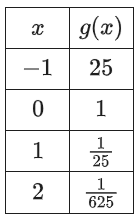
Question: For the exponential function , the table shows four values of and their corresponding values of . Which equation defines ?
A)
B)
C)
D)
Few Basics You Must Know:
1. Divide a fraction means:
, This is how divide works to fraction value.
2. We are learning Math here too, so below I explained how to do but questions like these, you must notice the hidden lines:
~ The table values, look closely to : They are all positive that means, there won’t be any negative value, so Option A and B are out. We are left with Option C and D.
3. How a Negative exponent works:
Then,
So -1 as an exponent will flip the fraction if you try to turn it into positive 1 like this:
Let’s solve the problem now.
🧠 Step-by-Step Mathematical Reasoning
Step 1: Use the most important exponential rule
For any exponential function:
Check the table:
✔ Valid exponential model
Step 2: Observe the pattern of change
Look at how values change as x increases:
Each step:
~ Divides by 25
This means:
~ The base is
~ The function represents exponential decay
Step 3: Write the function
✅ Correct Answer
Correct option: D
Option A ❌
~ Always negative
~ Table values are positive
Option B ❌
~ Always negative
~ Table values are positive
Option C ❌
At :
But table shows:
Wrong direction (growth vs decay)
🧮 Desmos (ACTUAL & PROPER USE)
1. Type all the values on the table in different lines:
(-1,25)
(0,1)
(1,1/25)
(2,1/625)
2. You will see points on the graph of all 4 values from the table with their respective color.
3. Type all options one-by-one:
g(x) = (1/25)^x
4. Observe:
~ You will see all 4 points are exactly on the curve of Option D.
✅ Verified perfectly
21th Question
Question: The first term of a sequence is 4. Each term after the first is 9 times the preceding term. If represents the th term of the sequence, which equation gives in terms of ?
A)
B)
C)
D)
Understand the Question
Given
~ First term of the sequence = 4
~ Each term after the first is 9 times the preceding term
~ represents the th term
Which equation gives in terms of ?
The phrase:
“Each term after the first is 9 times the preceding term”
tells us this is a geometric sequence.
For a geometric sequence, the general formula is: th term =
So why there is -1 in exponent
Let’s understand Geometric Sequence.
Each term after the first is 9 times the preceding term.
~ Term 1: 4
~ Term 2: in 2nd term, the 9 start 1st time = .
~ Term 3: in 3rd term, the 9 start 2nd time = .
~ Term 4: in 4th term, the 9 start 3rd time = .
~ Term 5: in 5th term, the 9 start 4th time = .
~ Term 6: in 6th term, the 9 start 5th time = .
~ Term 7: in 7th term, the 9 start 6th time = .
~ Term 8: in 8th term, the 9 start 7th time = .
~ Term 9: in 9th term, the 9 start 8th time = .
The 9 times are done.
➡️ The exponent is always one less than the term number
➡️ That is why the exponent is , not
This comes directly from the phrase “The first term of a sequence is 4″ in the question.
🧠 Step-by-Step Mathematical Solution
🔹 Step 1: Identify the type of sequence
Each term is multiplied by 9 to get the next term.
That means this is a geometric sequence.
🔹 Step 2: Recall the general formula for a geometric sequence
For a geometric sequence: th term =
Where:
= first term
= common ratio
= term number
🔹 Step 3: Substitute known values
From the problem:
~ First term
~ Common ratio
✅ Correct Answer: Option D
A) ❌
Trap:
~ Uses 4 as the ratio
~ Incorrect structure for a geometric sequence
B) ❌
Trap:
~ Swaps the first term and the ratio
~ SAT trap: wrong base in the exponent
C) ❌
Trap:
~ Starts exponent at t, not
~ This would make the first term:
Step-by-Step Solution
Step 1: Calculate the Value of q
The problem states that q is 75% less than 60. To find q:
q = 60 − (75% of 60)
q = 60 − 0.75 × 60
q = 60 − 45
Thus, q = 15.
Step 2: Calculate the Value of p
The problem states that p is 85% greater than q. This means p is equal to q plus 85% of q. To find p:
p = q + (85% of q)
p = q + 0.85 × q
p = 15 + 0.85 × 15
p = 15 + 12.75 = 27.75
Thus, p = 27.75.
Verification
~ Calculated q = 15 as 75% less than 60.
~ Calculated p = 27.75 as 85% greater than q.
Both steps are consistent with the problem’s conditions.
Final Answer: D) 27.75
22th Question
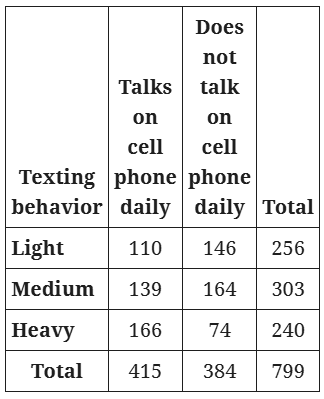
Question: In a study of cell phone use, 799 randomly selected US teens were asked how often they talked on a cell phone and about their texting behavior. The data are summarized in the table above. Based on the data from the study, an estimate of the percent of US teens who are heavy texters is 30% and the associated margin of error is 3%. Which of the following is a correct statement based on the given margin of error?
A) Approximately 3% of the teens in the study who are classified as heavy texters are not really heavy texters.
B) It is not possible that the percent of all US teens who are heavy texters is less than 27%.
C) The percent of all US teens who are heavy texters is 33%.
D) It is doubtful that the percent of all US teens who are heavy texters is 35%.
✅ Understand the QUESTION
Margin of Error & Statistical Interpretation
Given:
~ Sample size = 799 US teens
~ Estimated percent of heavy texters = 30%
~ Margin of error = ±3%
Question:
Which statement is correct based on the margin of error?
🧠 Step 1: Understand what “margin of error” actually means
Margin of error describes a range of plausible values for the true population percentage, not the sample.
So we compute the interval:
This means:
~ The true percent of all US teens who are heavy texters is likely between 27% and 33%
~ Values outside this range are unlikely, but not mathematically impossible
This interpretation is the core SAT concept.
D ✅ (Correct)
“It is doubtful that the percent of all US teens who are heavy texters is 35%.”
35% is outside the interval .
That makes it:
~ statistically unlikely
~ but not claimed as impossible
✔️ This matches the correct statistical interpretation.
A ❌
“Approximately 3% of the teens in the study who are classified as heavy texters are not really heavy texters.”
Margin of error:
❌ does NOT talk about misclassification
❌ does NOT describe individual errors
❌ does NOT refer to sample accuracy
This option completely misunderstands margin of error.
B ❌
“It is not possible that the percent of all US teens who are heavy texters is less than 27%.”
Margin of error does not say “impossible”.
It says: Values outside the interval are unlikely, not impossible
Absolute language = SAT red flag.
C ❌
“The percent of all US teens who are heavy texters is 33%.”
33% is only the upper bound of the interval, not a confirmed value.
Margin of error never gives an exact population value.
Did you try all the features and get comfortable using them? You should work on using the calculator and seeing references and directions. So be prepared for everything before taking the final SAT exam. The explanation of answers makes easier to learn and progress. You must try to work on your speed and spend less time on the beginning and more on the later questions. This is the SAT 2024 Practice Test of Math Module 1st.
There are more tests available:
- SAT 2024 Test (Math Module 2nd)
- SAT 2025 Test (Math Module 1st)
- SAT Test 5th (Math Module 2nd)
- SAT Test 4th (Reading and Writing Module 1st)
The best way to become a master in Math is to find the correct answer and understand why other options are incorrect. I wish you luck in your bright career.