Practice the 2026 SAT Math Test – Module 1st Full Solutions with Desmos Key Points
Prepare for the 2026 session of the SAT – here you will practice and learn SAT Math Module 1st questions. There are tricks to solve SAT math quickly with or without Desmos Calculator that you will learn here. This test is a practice test of 2026 SAT Math Module First. The best parts are:
- solutions of all questions,
- step-by-step explanations,
- how to verify the correct answer,
- description of correct and incorrect options,
- tips and tricks,
- and Desmos Calculator Hacks.
Like the other exams, it has the same format and all the necessary features for you to become a SAT master in math. You just take the Module 1st exam to practice your skills. The best part is that you practice within the time limit, and there are explanations of answers, tips and tricks to get a perfect score on the SAT. You will find Math easy after this.

ABOUT THE SAT MODULES
The SAT is divided into four modules. There are two categories with each split into two modules. The first category is “Reading and Writing” with two modules. The second category is “Math” with two modules. The one, you will do below is SAT Math 2026 Practice Test Module 1st.
The first module has questions ranging from easy to difficult, but the second module only contains difficult questions. If you want to take some other SATs, visit the links below.
- 1st Module of SAT Reading And Writing Practice Tests
- 2nd Module of SAT Reading And Writing Practice Tests
- 1st Module of SAT Math Practice Tests
- 2nd Module of SAT Math Practice Tests
THE SAT MATH MODULE 1ST
The first module of Math in SAT contains four segments: “Algebra,’ ‘Advanced Math,’ ‘Problem-Solving and Data Analysis,’ and ‘Geometry and Trigonometry.” The questions in Module 1st are from easy to difficult. In a real SAT exam, you must answer 22 questions within 35 minutes. We have provided you with the same in this Practice Test.
Instructions for the SAT Real-Time Exam: Tips Before Taking Tests
- Previous-and-Next: Like in real SAT exam, you can move freely from one question to another, same things you can do here. You select one option and move forward but you realized something, so you came back and change your option. You can do that here and in the real SAT exam too.
- Timer: On the top of the slide, you will see the timer, it starts from 0 and for Module 1st of Math you will get 35 minutes to finish 22 questions. Always try to finish the test before 35 minutes.
- Image: You can click on a graph, table, or other image to expand it and view it in full screen.
- Mobile: You cannot take the real exam on mobile, but our practice exam you can take on mobile phone.
- Calculator: Below the Test, you will see a Desmos calculator and graph for Math. The same, Desmos, will be used in real exams, so learn “How to use Desmos Calculator.”
- Answer All: Even if you do not know the correct answer of a question, still guess it because there is no Negative marking.
- Last Questions: The harder the question, the more marks it will fetch for you. So most likely, you will find later question difficult and more time-consuming, so utilize your time accordingly.
- Tips: This article will help you learn more about the SAT Exams. SAT: EVERYTHING ABOUT THE SAT
Wait for the Desmos Calculator to appear.
SAT MATH PROBLEM SOLUTIONS WITH STEP-BY-STEP EXPLANATION
Do not open the tabs before finishing the practice test above! For your convenience, we have compiled all the solutions and their explanations here. We will also give you some tips and advice to help you understand them better. You’ll see ‘why this answer is correct’ and ‘why this is incorrect.’
Math Solutions and Explanations:
The light red color shows the Question, green shows the Correct answer with step-by-step explanation, red shows the Incorrect one, and blue shows Desmos Tips or Tricks.
1st Question
Question: Sintel deposits $35 in a savings account at the end of each week. At the beginning of the 1st week of a year there was $600 in that savings account. How much money, in dollars, will be in the account at the end of the 4th week of that year?
A) 460
B) 740
C) 635
D) 639
Option B is correct.
🧮 Step-by-Step Correct Solution
Step 1: Understand the timing (CRITICAL SAT DETAIL)
~ Initial amount at beginning of week 1 = $600
~ Deposit = $35
~ Deposit happens at the end of each week
~ Total number of weeks = 4
So:
~ No deposit at the beginning
~ Deposit happens 4 times (end of week 1, 2, 3, 4)
Step 2: Find total deposited amount
Step 3: Add to the initial amount
✔ Amount at the end of the 4th week = $740
Option A: 460 ❌
How students get this:
They subtract instead of add:
This happens when students misread: “deposit” as “withdrawal”
❌ Direction error
Option C: 635 ❌
How students get this:
They add only one week’s deposit:
They forget:
~ Deposits happen every week
~ There are 4 weeks
❌ Incomplete counting
Option D: 639 ❌
How students get this:
They assume:
~ Deposit happens before week 1 starts
~ Or they add 39 instead of 35 due to careless reading
This option is a precision trap for rushed readers.
❌ Misreading + arithmetic slip
🧮 DESMOS CALCULATOR METHOD (SAT-REALISTIC)
Method 1: Table (Most Efficient)
1. Open Desmos
2. Click Table icon
3. Enter:
| week | amount |
|---|---|
| 0 | 600 |
| 1 | 600 + 35 |
| 2 | 670 + 35 |
| 3 | 705 + 35 |
| 4 | 740 |
Desmos confirms final amount = 740
Method 2: Expression Line
1. In Expression Line, type: 600 + 35*4
2. Desmos shows: 740
✔ Confirmed
2nd Question
Question: The function is defined by . For what value of does ?
A) 8
B) 9
C) 64
D) 80
✅ Correct Answer: B) 9
🧮 Correct Solution — Step by Step
We are told:
f(x) = 8x and f(x) = 72
That means: 8x = 72
[For what value of x does f(x) = 72? Take it as “Makes / Gives.” For what value of x makes f(x) = 72.]
Step 1: Isolate x
Divide both sides by 8 or simple solve it like this: 8x = 72
Step 2: Compute
x = 9
✔ So, the correct value of is 9.
Choice A is incorrect and may result from conceptual or calculation errors.
Choice C is incorrect and may result from conceptual or calculation errors.
Choice D is incorrect and may result from conceptual or calculation errors.
🧮 DESMOS CALCULATOR — SAT-REALISTIC METHOD
Method 1: Graph Intersection (Most Visual)
1. Open Desmos
2. In Expression Line 1, type: y = 8x
3. In Expression Line 2, type: y = 72
4. Click the intersection point
Desmos displays: (9, 72)
✔ x-value = 9
Method 2: Table (Fastest on SAT)
1. Click the Table icon next to y = 8x
2. Try values from options:
x = 8 → y = 64
x = 9 → y = 72 ✅
✔ Confirmed
✅ FINAL ANSWER: 9
3rd Question
Question: In , the measure of is and the measure of is . What is the measure of ?
A)
B)
C)
D)
✅ Understand the QUESTION — Triangle Angle Sum
Question Explained
You are given:
You are asked to find:
📐 Important Rule / Formula
Triangle Angle Sum Rule
This rule applies to every triangle, no exceptions.
🧠 Step-by-Step Solution
Add known angles:
Subtract from 180°:
✅ Correct Answer: Option C
❌ Why Other Options Are Incorrect
~ 43° → subtracting incorrectly
~ 89° → confusing sum of known angles with missing angle
~ 179° → forgetting triangle angle rule
⚠️ Very Common Mistake: assuming the third angle is just “what looks reasonable” instead of computing it.
🧮 Desmos Trick
Type: 180 – (23 + 66)
Desmos returns 91
4th Question
Question: If , what is the value of ?
A) -1
B) -6
C) -22
D) -24
Option B: The correct answer is -6.
Step-by-Step Solution
Step 1: Understand Question
~ The equation does not ask directly for x.
~ It asks for x – 7
Step 2: Let’s find out x
Given Equation:
4x – 28 = -24
4x = 28 – 24
4x = 4
Divide both side by 4 or move 4 to the right-hand side: 4x = 4
x = 1
Step 2: Find x – 7
x – 7
1 – 7
-6
✅ Correct Answer: -6
Option A: -1 ❌
Trap: Student forgets to subtract 7 and stops at x=1.
Option C: -22 ❌
Trap: Student subtracts 28 incorrectly:
Option D: -24 ❌
Trap: Student gives the right-hand side of the equation as the answer.
🧮 DESMOS CONFIRMATION
1. Open Desmos
2. Type: 4x – 28 = -24
3. Desmos shows: x = 1
4. Manually compute: 1 – 7 = -6
✔ Confirmed
5th Question
Question: Triangle is similar to triangle , where angle corresponds to angle , and angles and are right angles. If , what is the value of ?
A)
B)
C)
D)
✅ Understand the QUESTION — Similar Triangles & Trigonometric Ratios
Question Explained
You are told:
~ Triangle ABC is similar to triangle XYZ
~ Angle A ↔ X
~ Angles C and Z are right angles
~
You are asked to find cosY
📐 Important Rules / Definitions
1. Similar Triangles
If two triangles are similar, then:
~ Corresponding angles are equal
~ Corresponding side ratios are equal
~ Corresponding trigonometric ratios are equal
2. Trigonometric Definition
🧠 Step-by-Step Solution
Because:
Triangle ABC ∼ Triangle XYZ
Angle B corresponds to angle Y
➡️ Their cosine values must be equal
So:
Given:
Therefore:
✅ Correct Answer: Option A
❌ Why Other Options Are Incorrect
1/34 → random change, no geometric reason
32/33 → sine-like ratio, not cosine
33/34 → incorrect hypotenuse assumption
⚠️ Common SAT Trap: thinking cosine changes just because the triangle changes size. It does not if triangles are similar.
🧮 Desmos Insight
Trigonometric ratios stay constant for similar triangles — Desmos confirms this if you scale triangles. For this, we do not need Desmos.
6th Question
Question: Which of the following is a solution to the equation ?
A) 1
B) 2
C) 3
D) 4
✅ STEP 1: MATHEMATICAL SOLUTION
Move all terms to one side to form a quadratic:
Factor:
So:
take -2 on the right-hand side or do addition on both side by 2:
take 2 on the right-hand side or subtract both side by 2:
Only positive options are given.
✔ Correct Option B: 2
❌ 1
Trap: Guessing or incomplete simplification
❌ 3
Trap: Plugging loosely without equality check
Fails the equation
❌ 4
Trap: Confusing solution with constant term
Fails when substituted
DESMOS METHOD
Type:
y = 2x^2 – 4
y = x^2
What to do:
~ Click intersection points
~ Desmos shows intersections at x = ±2
Only 2 is listed.
7th Question
Question: The point (8, 2) in the xy-plane is a solution to which of the following systems of inequalities?
A)
x > 0
y > 0
B)
x > 0
y < 0
C)
x < 0
y > 0
D)
x < 0
y < 0
Choice A is correct.
🧮 Step-by-Step Solution
A point satisfies a system of inequalities if both coordinates satisfy both inequalities.
Given point: (8,2) = (x, y)
Step 1: Check the sign of
So any correct option must include:
Eliminate Options C and D immediately.
Step 2: Check the sign of
So any correct option must include:
This eliminates Option B.
✅ Correct Answer: A)
Choice B is incorrect and may result from conceptual or calculation errors.
Choice C is incorrect and may result from conceptual or calculation errors.
Choice D is incorrect and may result from conceptual or calculation errors.
🧮 DESMOS CONFIRMATION
1. Open Desmos
2. Plot the point: (8, 2)
3. Observe location: first quadrant
4. First quadrant corresponds to: x > 0, y > 0
✔ Confirmed
8th Question
| Voice type | Number of singers |
|---|---|
| Countertenor | 4 |
| Tenor | 6 |
| Baritone | 10 |
| Bass | 5 |
Question: A total of 25 men registered for singing lessons. The frequency table shows how many of these singers have certain voice types. If one of these singers is selected at random, what is the probability he is a baritone?
A) 0.10
B) 0.40
C) 0.60
D) 0.67
Understanding the Question
~ Total singers = 25
~ Baritones = 10
~ Find probability that a randomly selected singer is a baritone
Key Formula (Probability)
Step-by-Step Solution
Simplify:
✅ Correct Answer – Option B: 0.40
❌ Why the Other Options Are Wrong
0.67 → incorrect fraction, not from table
0.10 → uses countertenors (4/40 mistake)
0.60 → confusing with non-baritones
Use DESMOS as a calculator only.
9th Question
Question: The function is defined by . What is the value of ?
A.
B.
C. 5
D. 25
Mathematical solution
~
~
Substitute x = 3:
Correct answer: 5
Choice A is incorrect and may result from conceptual or calculation errors.
Choice B is incorrect and may result from conceptual or calculation errors.
Choice D is incorrect and may result from conceptual or calculation errors.
Desmos – correct evaluation method
1. Open desmos.com/calculator
2. Type: r(x) = sqrt(8x + 1)
3. On a new line, type: r(3)
4. Desmos immediately outputs: 5
✔ This is the official SAT-approved Desmos evaluation trick
10th Question
Question: At a certain time and day, the Washington Monument in Washington, DC, casts a shadow that is 300 feet long. At the same time, a nearby cherry tree casts a shadow that is 16 feet long. Given that the Washington Monument is approximately 555 feet tall, which of the following is closest to the height, in feet, of the cherry tree?
A) 10
B) 20
C) 30
D) 35
✅ Understand the QUESTION — Similar Triangles (Shadows & Heights)
Question Explained
At the same time of day:
Washington Monument:
~ Height = 555 ft
~ Shadow = 300 ft
Cherry tree:
~ Shadow = 16 ft
~ Height = ? (Assume it )
📐 Important Rule / Formula
Shadow Problems Use Similar Triangles
🧠 Step-by-Step Solution
Set up the proportion:
Washington Monument = Cherry tree
Simplify the left-hand side:
Multiply:
The Question asks the closest value, so
✅ Closest Answer: Option C
❌ Why Other Options Are Incorrect
10 → too small, ignores scale
20 → underestimates proportion
35 → overshoots actual value
⚠️ Common Mistake: adding or subtracting instead of forming a ratio.
🧮 Desmos Trick
1. Type: 555/300 * 16
2. Desmos gives 29.6
11th Question
Question: Line is defined by . Line is perpendicular to line in the xy-plane. What is the slope of line ?
A)
B)
C)
D)
Choice A is correct.
🧮 Step-by-Step Solution
~ The line j is perpendicular to line k in the xy-plane.
What is Perpendicular to line means: It means opposite reciprocal.
The opposite reciprocal of a number is -1 divided by the number. Thus, the …
The equation is already in slope–intercept form:
where m is the slope of the line and b is the y-coordinate of the y-intercept of the line
So the slope of line is:
The word perpendicular is the key instruction.
For perpendicular lines:
Step: Find the negative reciprocal
~ Opposite of Reciprocal is
~ Change the sign
~ We know mk is 3.
✅ Correct Answer: A)
Option B: − ❌
Trap: Student incorrectly multiplies slope by −1 and divides by 4.
Option C: − ❌
Trap: Student mistakenly multiplies 3 and 6 before taking reciprocal.
Option D: − ❌
Trap: Student uses the y-intercept (15) instead of the slope.
🧮 DESMOS CONFIRMATION
1. Open Desmos
2. Type:
y = 3x + 15
y = (-1/3)x
3. Observe the lines intersect at a right angle
✔ Confirmed
12th Question
Question: A table of the US minimum wage for 6 different years is shown below.
| Year | US minimum wage (dollars per hour) |
|---|---|
| 1960 | 1.00 |
| 1970 | 1.60 |
| 1980 | 3.10 |
| 1990 | 3.80 |
| 2000 | 5.15 |
| 2010 | 7.25 |
What was the percent increase of the minimum wage from 1960 to 1970?
A) 30%
B) 60%
C) 62.5%
D) 120%
Understanding the Question
~ Old value (1960): $1.00
~ New value (1970): $1.60
~ Find percent increase
Key Formula (Percent Increase)
Step-by-Step Solution
Step 1: Find the increase
Step 2: Divide by original value
Step 3: Convert to percent
✅ Correct Answer – Option B: 60%
❌ Why the Other Options Are Wrong
120% → confusing increase with final value
30% → halves the actual increase
62.5% → wrong base (dividing by 1.6 instead of 1.0)
Use Desmos as a calculator only.
13th Question
Question:
The given equation relates the positive numbers and . Which equation correctly expresses in terms of and ?
A)
B)
C)
D)
✅ MATHEMATICAL SOLUTION
The goal is to isolate x.
Add to both sides or just move 44y on the right-hand side:
This step is chosen because:
~ x is currently being reduced by
~ Undo subtraction by adding
✔ Correct Option: Option B
❌
Trap: Repeating the original structure
Fails to isolate x correctly
❌
Trap: Inventing multiplication
No multiplication exists in original equation
❌
Trap: Random division + sign error
Completely unrelated algebra
DESMOS TRICK
1. Type the question expression and options one-by-one in each different lines and check the graph.
2. You will see the Correct Option matches exactly the same with Question expression.
14th Question
Question:
A solution to the given system of equations is . What is the value of ?
A) 432
B) 54
C) 45
D) 18
🧠 Step-by-Step Mathematical Solution
Step 1: Use the value of
From the first equation:
Step 2: Substitute into the second equation:
Step 3: Calculate
✅ Correct: Option A
Choice B is incorrect and may result from conceptual errors.
Choice C is incorrect and may result from conceptual errors.
Choice D is incorrect and may result from conceptual errors.
🧮 Desmos Verification
1. Type: x = 3
2. In Second line type: y = (15 – x)^2
~ it will give 144
3. Just multiply in line third: 3*144
Here is your answer xy = 432
15th Question
Question: What is the slope of the graph of in the xy-plane?
[Type-Based Answer: In the final exam, you will type the answer rather than choose from options.]
🧠 Core Concept (Why we isolate y)
Slope is defined as:
So we must rewrite the equation in slope-intercept form.
🧮 Step-by-Step Solution
Step 1: Isolate the y-term
Subtract from both sides:
This step is necessary to get y by itself.
Step 2: Divide by −5 (why sign matters)
Dividing by a negative:
~ flips signs
~ ensures slope sign is correct
Step 3: Identify slope
The coefficient of is:
❌ −2
Mistake: Student forgets dividing by −5 flips the sign.
❌ −5
Mistake: Student thinks slope is attached to y.
🧮 Desmos Confirmation
1. Type: 10x – 5y = -12
2. Desmos shows slope with 2 points
~ Don’t assume 2 points as slope that is not what slope is
~ Click on both points one-by-one and notice
(x, y) = (-1.2, 0)
(x, y) = (0, 2.4)
❗ Important Confusion Cleared
“Desmos shows only one slope. Is 2 the slope or 2 points?”
🔹 2 is NOT two points
🔹 2 is the slope
What slope means:
~ For every +1 move in x
~ y goes up by 2
That’s why the line rises steeply
3. So Slope 2 means: double of x
~ doesn’t matter positive or negative
~ just double value.
~ Double of 1.2 is 2.4
Hence the slope is 2 (Double).
16th Question
Question: Which expression is equivalent to , where ?
A)
B)
C)
D)
🧠 Core Concept (Why factoring is required)
~ Numerator and denominator share a common factor
~ The restriction allows cancellation safely
~ SAT expects simplify completely
🧮 Step-by-Step Simplification
Step 1: Factor the numerator
Factor out : If you try to expand the below value, it will again turn back to above value.
Step 2: Factor the denominator & Factor out
Step 3: Cancel the common factor
Since , , so cancellation is valid:
✅ Correct Answer: B
Option A ❌
Trap: Student cancels incorrectly and loses the coefficient.
Option C ❌
Trap: Student expands but never simplifies.
Option C ❌
Trap: Student expands but never simplifies.
Real Desmos Trick & Steps
1. Type: (8x(x-7) – 3(x-7)) / (2x – 14)
2. Enter each options as a separate line:
A. (x-7)/5
B. (8x – 3)/2
3. Check the graph lines
~ Option B line matches exactly to question expression line
17th Question
Question: If and , which of the following is equivalent to ?
A)
B)
C)
D)
🧠 Core Concept (Why substitute first)
We have
~
~
You must replace every p and v with expressions in .
🧮 Step-by-Step Explanation
Step 1: Compute
Step 2: Compute
Step 3: Add
Step 4: Combine all terms
✅ Option B – Correct Answer: 3x² + 14x + 17
Option A: 3x² + 12x + 7 ❌
Trap: Student forgets one term.
Option C: 3x² + 19x + 20 ❌
Trap: Student stops after pv.
Option D: 3x² + 26x + 33 ❌
Trap: Student adds instead of subtracting .
DESMOS METHOD
METHOD 1: “Option Testing” (Most Reliable)
1. Type on line 1: p = 3x + 4
2. Type on line 2: v = x + 5
3. Type on line 3: e = p*v – 2p + v
4. Type on line 4:
~ Test all options one by one
e = 3x^2 + 14x + 17
5. When the option is correct, its line matches exactly to the equation on line 3.
~ Check the graph and you will see true / identical graph
That will be the correct option.
METHOD 2: Plug ONE Smart Number (Fastest)
1. Assume x is 1:
x = 1
2. Compute original expression
Type
~ On Line 1: p = 3*1 + 4 (it will show 7)
~ On Line 2: v = 1 + 5 (it will show 6)
~ On Line 3: pv – 2p + v (it will show 34)
3. Type option one-by-one filling the value into x
A) 3(1)^2 + 12*1 + 7 = 22 ❌
B) 3(1)^2 + 14*1 + 17 = 34 ✅
✔ Only Option B matches.
18th Question
Question:
The Karvonen formula above shows the relationship between Alice’s target heart rate , in beats per minute (bpm), and the intensity level of different activities. When = 0, Alice has a resting heart rate. When = 1, Alice has her maximum heart rate. It is recommended that be between 0.5 and 0.85 for Alice when she trains. Which of the following inequalities describes Alice’s target training heart rate?
A)
B)
C)
D)
🧠 Core Concept (Why we substitute endpoints)
Because is a linear function, the minimum and maximum values of h occur at the endpoints of the interval for .
So we evaluate:
→ maximum training heart rate
→ minimum training heart rate
🧮 Step-by-Step Solution
Step 1: Find the minimum training heart rate
Substitute :
Step 2: Find the maximum training heart rate
Substitute :
Step 3: Write the inequality
✅ Correct Answer: A
Option B: ❌
Trap: Student uses only the increase part 120p and forgets the +60.
Option C: ❌
Trap: Student includes resting heart rate instead of training range.
Option D: ❌
Trap: Student uses incorrect endpoints.
🧮 Desmos Confirmation
1. Do not type this: h = 120p + 60
~ Desmos answers are based on intersect points on graph
~ and graph only has (x, y)
2. Let’s replace p to x and h to y
~ Type: y = 120x + 60
3. But here we do not need to write x, just write the value of p directly
y = 120*0.5 + 60, you will get 120
y = 120*0.85 + 60, you will get 162
Option A
To confirm the interval
1. Type: y = 120x + 60
2. In second line type: x = 0.5
3. In third line type: x = 0.85
4. Check the graph
5. You will see interval between them, which confirms Option A.
19th Question
Question: The score on a trivia game is obtained by subtracting the number of incorrect answers from twice the number of correct answers. If a player answered 40 questions and obtained a score of 50, how many questions did the player answer correctly?
[Type-Based Answer: In the final exam, you will type the answer rather than choose from options.]
Understand the Question
The score is calculated by:
~ subtracting incorrect answers
~ from twice the number of correct answers
Given:
~ Total questions = 40
~ Score = 50
How many questions were answered correctly?
🧠 Core Concept (Why define variables)
Let:
~ = number of correct answers
~ Incorrect answers =
Score rule:
🧮 Step-by-Step Solution
Step 1: Write the score equation
This step is essential because:
~ incorrect answers depend on correct ones
Step 2: Simplify
Step 3: Solve for
✅ Correct Answer: 30
❌ 25
Mistake: Student sets , ignoring incorrect answers.
❌ 25
Mistake: Student sets , ignoring incorrect answers.
❌ 40
Mistake: Student assumes no incorrect answers.
🧮 Desmos Confirmation
1. Do not type this: 2c – (40 – c) = 50
~ Desmos answers are based on intersect points on graph
~ and graph only has (x, y)
2. Let’s replace c to x
~ Type: 2x – (40 – x) = 50
3. Check on the graph
4. Click any where on the line, you will see 30 on x-axis
(x, y) = (30, …)
✔ Solution:
20th Question
Question: A physics class is planning an experiment about a toy rocket. The equation gives the estimated height , in feet, of the toy rocket seconds after it is launched into the air. Which of the following is the best interpretation of the vertex of the graph of the equation in the -plane?
A. This toy rocket reaches an estimated maximum height of 502 feet 16 seconds after it is launched into the air.
B. This toy rocket reaches an estimated maximum height of 502 feet 5.6 seconds after it is launched into the air.
C. This toy rocket reaches an estimated maximum height of 16 feet 502 seconds after it is launched into the air.
D. This toy rocket reaches an estimated maximum height of 5.6 feet 502 seconds after it is launched into the air.
Understand Question and Options
Which statement best interprets the vertex?
Options
A) Max height 502 ft after 16 seconds
B) Max height 502 ft after 5.6 seconds
C) Max height 16 ft after 502 seconds
D) Max height 5.6 ft after 502 seconds
🧠 Core Concept (Vertex form meaning)
Vertex form:
~ Vertex is
~ If , vertex is a maximum
~ Like here:
🧮 Step-by-Step Interpretation
Given:
So:
→ time in seconds
→ height in feet
Negative coefficient → maximum height
~ Since (negative), the parabola opens downward
~ So the vertex is the maximum height
Meaning of the vertex
~ The rocket reaches its maximum height
~ Height = 502 feet
~ Time = 5.6 seconds after launch
✅ Correct Answer: B
Option A ❌
Trap: Student confuses coefficient −16 with time.
Option C ❌
Trap: Student swaps x and y meanings.
Option D ❌
Trap: Completely misreads vertex form.
Open Desmos
1. Type: y = -16(x – 5.6)^2 + 502
2. Check the graph:
~ click the highest point of the graph
~ Desmos shows: (5.6, 502)
21th Question
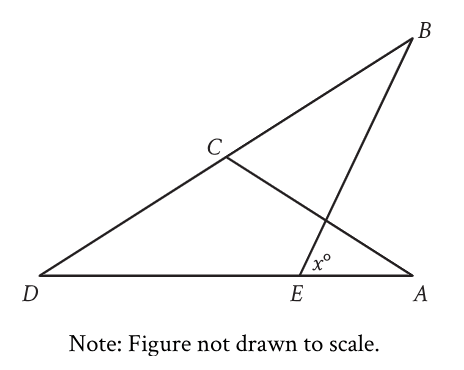
Question: In the figure, . The measure of angle is and the measure of angle is . What is the value of ?
A)
B)
C)
D)
✅ Understand the QUESTION — Angle Chasing with Isosceles Triangle
Given
Find
1️⃣ What the Question Is Testing
This is classic SAT geometry combining:
~ Isosceles triangle rules
~ Triangle angle sum
~ Linear angles
~ Angle chasing using shared points
2️⃣ Key Geometry Rules Used
📌 Isosceles Triangle Rule
If two sides are equal, the angles opposite them are equal.
Since:
Triangle is isosceles.
📌 Triangle Angle Sum
and
📌 Linear Pair Rule
Angles on a straight line sum to:
Just like to find
3️⃣ Step-by-Step Angle Chasing
🔹 Step 1: Find base angles of
Given:
Remaining angle sum:
Since triangle is isosceles:
We know from above that isosceles two sides are equal,
so we equally divide the
🔹 Step 2: Find :
We know based on given figure that measures the same as .
So:
In question,
🔹 Step 3: Find :
In order to find , look at the given figure.
~ Since angle DEB and angle AEB form a straight line, they are supplementary angles, so the sum of the measures of these angles is
✅ Correct Answer: Option C
❌ Why the Other Options Are Traps
❌ 59° → subtracting angle EBC to angle ACD directly
❌ 76° → believing that after calculating angle ACD, the work is done.
❌ 97° → assuming angle DEB and angle AEB are the same.
SAT geometry punishes skipping structure.
🧮 Desmos?
🚫 Not applicable
~ Desmos cannot measure unknown angles without coordinates
~ This is pure logical angle-chasing
22th Question
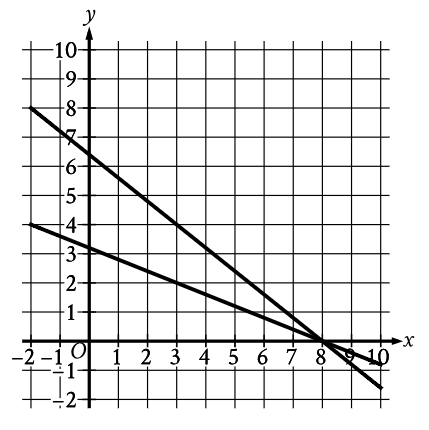
Question: What system of linear equations is represented by the lines shown?
A) 8x + 4y = 32
-10x – 4y = -64
B) 4x + 10y = 32
-8x – 10y = -64
C) 4x – 10y = 32
-8x + 10y = -64
D) 8x – 4y = 32
-10x + 4y = -64
Option B: (Graph shows two decreasing straight lines intersecting at the x-axis around )
🔍 Step-by-Step Graph Analysis
From the graph, we clearly observe:
• Both lines are sloping downward (negative slope)
• The two lines intersect exactly on the x-axis
• The point of intersection is approximately (x, y) = (8, 0)
• One line is steeper than the other
• The y-intercepts look close to 3–4 for one line and 6–7 for the other
So the correct system must satisfy all of these features.
🧮 Check Option B Carefully (Why It Works)
Method 1:
Equation 1: 4x + 10y = 32
Convert to slope-intercept form: 10y = −4x + 32
y = -4x + 32 divided by 10
y = −0.4x + 3.2
• Negative slope ✔
• y-intercept ≈ 3.2 ✔
• Matches the lower line in the graph ✔
Equation 2: −8x − 10y = −64
Multiply by −1: 8x + 10y = 64 (This step is optional)
Solve for y: 10y = −8x + 64
y = −0.8x + 6.4 divided by 10
y = −0.8x + 6.4
• Negative slope ✔
• Steeper than the first line ✔
• y-intercept ≈ 6.4 ✔
Without the optional step above
Minus will also be divided
Intersection Check (CRITICAL)
Set equations equal:
y of Equation 1 = y of Equation 2
You can choose any equation to find out x. The x will be the same.
−0.4x + 3.2 = −0.8x + 6.4
Let’s pick equation 1:
when you remove dot, you will end up 10 on both. We also cut minus on both.
Let’s try equation 2 also
The x value matches to the graph, now let’s check y as well.
Method 2: The Quickest Method (Use this when only one value is exactly the same in both like here 10y)
4x + 10y = 32
-8x – 10y = -64
Equation 1:
Equation 2:
The simplest and quickest way to solve is to put both equation together like this:
The x value matches to the graph, now let’s check y as well.
Substitute : Now let’s try to fill the value of x and confirm the value of y. Again, the answer will be the same in both equation. For now, we are picking Equation 1.
y = -0.4x + 3.2
y = −0.4(8) + 3.2
y = -3.2 + 3.2
y = 0
✔ Intersection point = (8, 0)
✔ y-intercepts are 3.2 and 6.4 → graph also shows this, something between (3-4) and (6-7)
✔ Exactly matches the graph
✅ Option B is correct
Option A ❌
First equation: 8x + 4y = 32
⇒ 4y = -8x + 32
⇒ y = -8x + 32 divided by 4
⇒ y = −2x + 8
[If you calculate like above, the value of x will be: x = 4. It doesn’t match with the graph. It is incorrect, but if you still want to try for knowledge then continue.]
Second equation: −10x − 4y = −64
⇒ -4y = 10x – 64
⇒ y = 10x – 64 divided by -4
(If in doubt, how to divide then look above the “Without Optional Step.”)
⇒ y = −2.5x + 16
[Here the x will be: x = 6.4. Based on graph, the x should be 8.]
[All you need to do is find x value then calculate y, just like above. The same steps like Option B.]
• y-intercepts are 8 and 16 → graph does NOT show this (
• x is 4 and 6.4 → graph does NOT show this
• y is 0, matches with graph but without x. It is incorrect.
• Slopes are too steep
• Intersection is NOT at (8, 0)
❌ Rejected
Option C ❌ It is a Trap.
Equation 1: 4x − 10y = 32
⇒ y = 0.4x − 3.2
[Here x-intercept is 8. Calculate x like Option B. Let’s find out y.]
y = 0.4(8) – 3.2
⇒ y = 3.2 – 3.2
⇒ y = 0
(Since the Equation 1 matches with the graph, let’s confirm by checking Equation 2, because both should give the same value.)
Equation 2: -8x + 10y = -64
⇒ y = 0.8x – 6.4
[Here x-intercept is 8. Calculate x like Option B. Let’s find out y.]
⇒ y = 0.8(8) – 6.4
⇒ y = 6.4 – 6.4
⇒ y = 0
⚠️ Same as Option B
The REAL Deciding Factor (This Is the Key Point)
The question is NOT: “Which system intersects at (8, 0)?” (If it was then we focus on final values.)
The question is: “Which system matches the LINES SHOWN?”
That means we must match:
– intersection
– direction of slope
– orientation of the lines
From the EQUATION (Algebra Rule): y = mx + b
Option B – Both equations are -0.4x + 3.2 = -0.8x + 6.4
m = -0.4 (Equation 1), -0.8 (Equation 2)
📌 Both slopes are NEGATIVE (The definition of Negative slope: as x increases, y decreases.)
📌 Lines go downward left to right
📌 Exactly matches the graph
Option C – Both equations are 0.4x – 3.2 = 0.8x – 6.4
m = 0.4 (Equation 1), 0.8 (Equation 2)
📌 Both slopes are POSITIVE
📌 Lines go upward left to right
📌 This is the OPPOSITE of the graph
❌ Rejected
Option D ❌
Equation 1: 8x − 4y = 32
⇒ y = 2x − 8
[Here x-intercept is 4. Calculate x like Option B. Since it is clearly incorrect but still let’s find out y.]
y = 2(4) – 8
⇒ y = 8 – 8
⇒ y = 0
(The Equation 1 doesn’t match with the graph.)
• Positive slope
• Does not match graph direction
❌ Rejected
Memory rule for students: On graph if
Left high → right low = negative slope
Left low → right high = positive slope
The sign of m decides direction: y = mx + b
Slope (m) is Positive (+) = Line direction (Upward left → right)
Slope (m) is Negative (−) = Line direction (Downward left → right)
🧮 DESMOS CALCULATOR — EXACT SAT METHOD
Step-by-Step in Desmos
1. Open Desmos Calculator
2. In Expression Line 1, type: 4x + 10y = 32
→ Desmos automatically graphs the line
3. In Expression Line 2, type: -8x – 10y = -64
4. Click on the intersection point shown on the graph
→ Desmos displays: (8, 0)
5. Zoom in using mouse scroll / zoom buttons
6. Confirm:
– Both slopes go downward
– One line is steeper
– Intersection lies exactly on x-axis
✅ Desmos confirms Option B
Did you try all the features and get comfortable using them? You should work on using the calculator and seeing references and directions. So be prepared for everything before taking the final SAT exam. The explanation of answers makes easier to learn and progress. You must try to work on your speed and spend less time on the beginning and more on the later questions. This is the SAT 2026 Practice Test of Math Module 1st.
There are more tests available:
- SAT 2024 Test (Math Module 2nd)
- SAT 2025 Test (Math Module 1st)
- SAT Test 5th (Math Module 2nd)
- SAT Test 4th (Reading and Writing Module 1st)
The best way to become a master in Math is to find the correct answer and understand why other options are incorrect. I wish you luck in your bright career.