


Learn More About Past Perfect Tense: The Complete Guide With Clear Differences And Examples
The Past Perfect tense can feel confusing, especially when deciding whether an action is “old,” “very old,” “changed,” or “finished before another past action.” This guide breaks everything down with simple explanations, powerful examples, and clear rules so you can finally understand when and why we use the Past Perfect tense.
By the end of this page, you will understand very old completed actions, changed actions, earlier vs. later past events, and time-up-to-then situations — the four pillars of Past Perfect.
Table of Contents
- What Is the Past Perfect Tense? (Simple and Complete Definition)
- The Difference Between Had OR Would In English? (The Confusion Explained Simply) = ’d
- Uses of Past Perfect Tense (With 50+ Real-Life Examples)
- What is the difference between Past Perfect and Present Perfect Tense?
- Learn More About Specified vs. Unspecified Time
- Frequently Asked Questions: Most Important
- Practice and Prepare Past Perfect Tense With Simple Learning Exercises
What Is the Past Perfect Tense? (Simple and Complete Definition)
The Past Perfect tense shows that one action happened before another past action or past time.
It highlights something that was already completed, changed, or finished long before another event happened.
Past Perfect means ‘very old completed action.’
How do you define very old in numbers? = 2 months, 5 years, 10 years, 3 days, or 2 years…
The answer is down below.
KJ – What is the definition of Past Perfect?
Mr English – Uhhhh! Past Perfect! Completed action.
KJ – Kind of! The definition is based on its name Past Perfect. A time that is past (old, changed, or completed) and perfect (old, changed, or completed).
Old, changed, or completed + Old, changed, or completed = Very old, changed, or completed action.
KJ – CONFUSED? TAKE A LOOK BELOW TO UNDERSTAND IT CLEARLY!
Short Definition
Past Perfect = A very old, changed, or completed action that happened before another past action.
Why It’s Called “Past Perfect”
- Past = Already happened (old)
- Perfect = Completed, finished
So Past Perfect = very old / very completed action.
The Real-Life Meaning of “Very Old Completed Action”
“How old is ‘very old’?”
It can be 2 months, 3 days, 10 years, 20 minutes, or even a moment before another action — as long as one action happened earlier than another.
For example:
– He called me a minute ago after I had sent a message.
– The Smart-Age had started many years before he was born.
Past Perfect Tense Formula & Structure
The One And Only Past Perfect Formula / Rule
Had + verb 3rd form = I, he, she, it, we, you, they, this, that, these, those, there, here, singular noun, plural nouns, etc.
The Structure of Past Perfect Format
- Affirmative = Subject + had + verb 3rd from + other words.
- I had finished my work.
- Negative = Subject + had + not + verb 3rd from + other words.
- She had not called me.
- Simple Interro (Yes-No Question) = Had + subject + verb 3rd form + other words?
- Had they arrived?
- Simple Interro Negative = Had + subject + not + verb 3rd from + other words?
- Had you not slept?
- Interrogative (WH-Question) = Wh-family + had + subject + verb 3rd form + other words?
- Why had he left early?
- Interrogative Negative = Wh-family + had + subject + not + verb 3rd form + other words?
- Why had he not left early?
The Difference Between Had OR Would In English? (The Confusion Explained Simply) = ’d
Abbreviation of Had = “Had” short form is ” ‘d ” = I’d, He’d, She’d, We’d, They’d, It’d, or Noun’d, etc.
Abbreviation of Would = “Would” short form is ” ‘d ” – I’d, He’d, She’d, We’d, They’d, It’d, or Noun’d, etc.
But the difference is depended on “Verb form.”
– “Had” comes with “verb 3rd form” = I‘d invited my friends.
– “Would” comes with “verb 1st form” = I‘d invite my friends.
Verb form tells you the difference.
Uses of Past Perfect Tense (With 50+ Real-Life Examples)
Very Old Completed Action
Examples:
- I had admitted to my school a long time ago.
- He had cast me for this movie.
- They had desired to become doctors.
- Moira had wanted to be an English teacher.
- What had you posted there?
- Had you really informed me before?
Changed Action or Event
You planned something, but the situation changed. You did not do it. In speaking “Had” is often stressed.
Examples:
- I had planned to go to the party but there was raining outside.
- Dora had wanted to be an English teacher when she was young.
- He had cast me for this movie but later he cast someone else.
- I had booked my ticket but I did not go.
- Why had you not gone there?
Completed Action Before Another Past Action
An action or event that was completed earlier than the others. We use Past Perfect for earlier actions or events. We use “Past Simple,” “Simple Past,” “Past Continuous,” “Past Modals,” or “Any Past Verbs” for later actions or events.
The earliest action = Past Perfect
The later action = Simple Past / Past Continuous / Past Modals
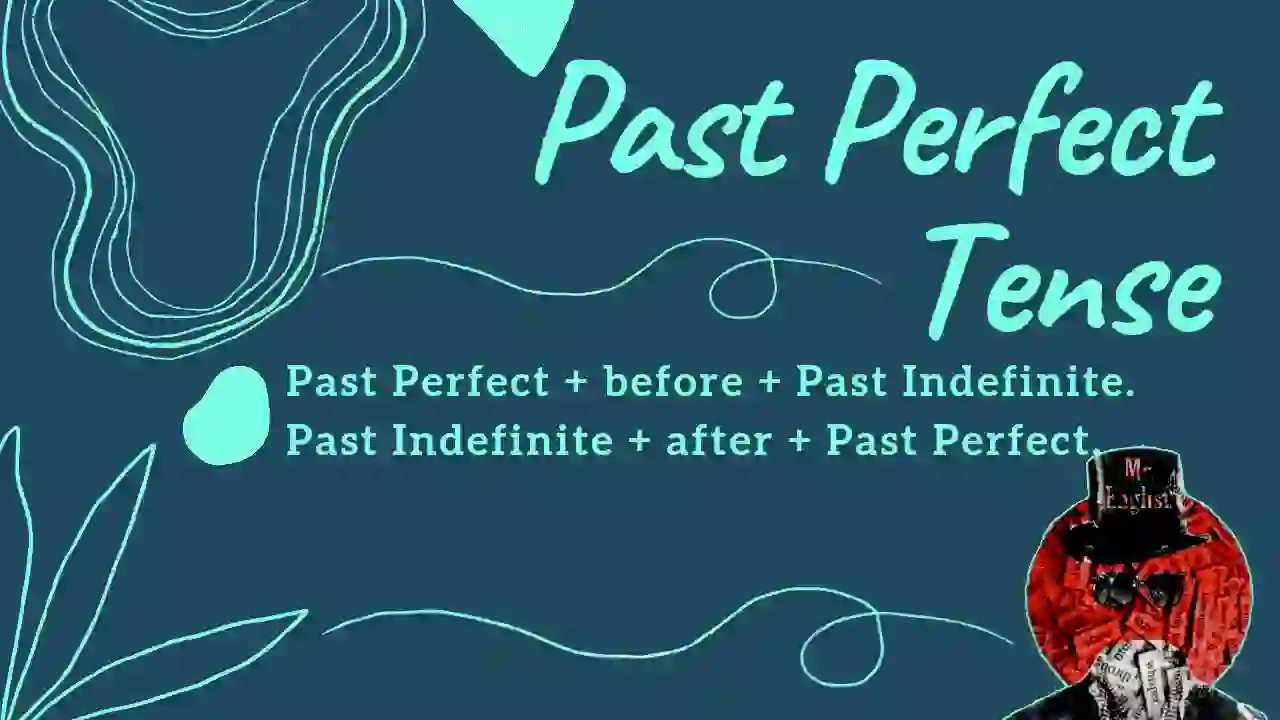
How to use Before and after in Past Perfect Tense

Examples: (The underlined sentence has completed earlier than the bold sentence.)
- I had taken admission to my school before my friend took it.
or
- Before my friend took admission to my school, I had taken admission to my school.
- He cast me for this movie after he had rejected them.
or
- After he had rejected them, he cast me for this movie.
- They had desired to be a doctor before they became an engineer.
or
- Before they became an engineer, they had desired to be a doctor.
- The police arrived after they had beaten him.
or
- After they had beaten him, the police arrived.
What is the difference between Past Perfect and Present Perfect Tense?
Past Perfect refers to a point in time that started in past and ended in past. Present Perfect refers to a time that started in past but ended or continued in present.
Past Perfect = Had + verb 3rd form. Use Past Perfect when referring to time up to a past moment.
Present Perfect = Have / Has + verb 3rd form. Use Present Perfect when referring to time up to now, present moment.
Examples:
Past Perfect Examples — Time up to THEN
- I had seen all movies by the time I was 18.
- (I watched all movies before I turned 18.)
- When I retired, my son had got married for nearly twenty years.
- (My son was married for nearly 20 years before my retirement.)
- I had achieved my degree by 2005.
- (I got my degree before 2005.)
Present Perfect Examples — Time up to NOW
- I have seen all movies.
- (The effect is real in present too.)
- My son has got married for nearly twenty years.
- (The result is still present.)
- I have achieved my degree.
- (Completed but effect shows a present result.)
Learn More About Specified vs. Unspecified Time
Specified Time (Clear Time Mentioned)
Use Past Perfect when the time is clear, fixed, or exact.
Examples:
- I had finished the project by 2010.
- She had left before 8 PM.
- They had bought the house in 2002.
Unspecified Time (No Clear Time Mentioned)
Still Past Perfect — if the action happened before another past event even without a specific timestamp.
Examples:
- He had already eaten when I arrived.
- I had never visited Delhi before we moved there.
- She had just finished her dinner when I called.
Examples for “When, How Long, How Often” in Past Perfect
WHEN (Very Old or Earlier Past Action)
- When I reached, they had already left.
- When she called, I had slept.
HOW LONG (Duration up to a point in the past)
Use had + been + -ing or regular Past Perfect depending on context.
Examples:
- I had worked there for 5 years before I quit.
- She had lived in Paris since 2002 before she moved to Rome.
- They had waited for two hours before the gate opened.
HOW OFTEN (Frequency before another past moment)
Examples:
- I had visited that park many times before it closed.
- She had never met him before that day.
- We had rarely travelled before 2010.
Frequently Asked Questions: Most Important
What is the main use of Past Perfect?
To show that one action happened earlier than another past action.
What is the difference between Present Perfect and Past Perfect?
Present Perfect = action relevant to now / present time (action that has ended in present.)
Past Perfect = action relevant to then / past time (action that has started and ended in past.)
Is Past Perfect always necessary?
No. Use it only when two past actions need clear order. The best choice is to use Past Indefinite Tense.
Can I use Past Perfect without another action?
Yes, when the sentence itself suggests a very old completed event.
“Had” vs “Would” short form — how to identify?
Look at the verb form:
Verb 3rd = Had + V3
Verb 1st = Would + V1
How do I master the differences better in Present Perfect and Present Perfect Continuous Tense?
You should follow these steps:
1. Read the whole article on Present Tense.
2. Go through all examples and use them in real life.
3. Try to take all the English tests available.
4. Try to practice by making sentences yourself and reply in comment section. We will correct your mistakes and improve your skills.
Practice and Prepare Past Perfect Tense With Simple Learning Exercises
Beginner Friendly Exercise With Four Options Each
Practice the tense with these interactive quizzes: It has a balanced touch of basic to advanced questions. [The content will be here soon.]
- One: Exercise 1
- Two: Exercise 2
- Three: Exercise 3
- Four: Exercise 4
- Five: Exercise 5
- Six: Exercise 6
- Seven: Exercise 7
- Eight: Exercise 8
- Nine: Exercise 9
- Ten: Exercise 10
Fill In The Blanks Quiz: Learn English With Paragraphs
Slightly more difficult then above quiz, there you will fill the blanks in the paragraphs.
- One: Paragraph Exercise 1
- Two: Paragraph Exercise 2 [The content will be here soon.]
Story Time: Learn and Improve English With Story Tests
The most useful exercises in English, you will learn English by filling interesting story gaps. You will improve not only you English but also vocabulary. [The content will be here soon.]
Advice – Never learn any language using another language. You should learn English in English, not in your native language (mother-tongue). Just like you learned your mother tongue in your own mother tongue. By learning in this way, only makes your English accurate, fluent, and you learn it like a Pro.
Practice in Comment Section: I assure our Team will correct your grammatical mistakes there.