Practice the 2026 SAT Math Test – Module 2nd All Solutions with Desmos Key Points
How was your Module 1st? How much have you scored? Please tell us in the comment. The SAT math seems tough without Desmos Calculator. Fear not, we have provided you solutions of all questions with Desmos tricks. This test is a practice test of 2026 SAT Math Module Second. The best parts are:
- solutions of all questions,
- step-by-step explanations,
- how to verify the correct answer,
- description of correct and incorrect options,
- tips and tricks,
- and Desmos Calculator Hacks.
Like the other exams, it has the same format and all the necessary features for you to become a SAT master in math. You just take the Module 2nd exam to practice your skills. The best part is that you practice within the time limit, and there are explanations of answers, tips and tricks to get a perfect score on the SAT. You will find Math easy after this.

ABOUT THE SAT MODULES
The SAT is divided into four modules. There are two categories with each split into two modules. The first category is “Reading and Writing” with two modules. The second category is “Math” with two modules. The one, you will do below is SAT Math 2026 Practice Test Module 2nd.
The first module has questions ranging from easy to difficult, but the second module only contains medium to difficult questions, no easy. If you want to take some other SATs, visit the links below.
- 1st Module of SAT Reading And Writing Practice Tests
- 2nd Module of SAT Reading And Writing Practice Tests
- 1st Module of SAT Math Practice Tests
- 2nd Module of SAT Math Practice Tests
THE SAT MATH MODULE 2ND
The second module of Math in SAT contains four segments: “Algebra,’ ‘Advanced Math,’ ‘Problem-Solving and Data Analysis,’ and ‘Geometry and Trigonometry.” The questions in Module 2nd are from medium to difficult. In a real SAT exam, you must answer 22 questions within 35 minutes. We have provided you with the same in this Practice Test.
Instructions for the SAT Real-Time Exam: Tips Before Taking Tests
- Previous-and-Next: Like in real SAT exam, you can move freely from one question to another, same things you can do here. You select one option and move forward but you realized something, so you came back and change your option. You can do that here and in the real SAT exam too.
- Timer: On the top of the slide, you will see the timer, it starts from 0 and for Module 1st of Math you will get 35 minutes to finish 22 questions. Always try to finish the test before 35 minutes.
- Image: You can click on a graph, table, or other image to expand it and view it in full screen.
- Mobile: You cannot take the real exam on mobile, but our practice exam you can take on mobile phone.
- Calculator: Below the Test, you will see a Desmos calculator and graph for Math. The same, Desmos, will be used in real exams, so learn “How to use Desmos Calculator.”
- Answer All: Even if you do not know the correct answer of a question, still guess it because there is no Negative marking.
- Last Questions: The harder the question, the more marks it will fetch for you. So most likely, you will find later question difficult and more time-consuming, so utilize your time accordingly.
- Tips: This article will help you learn more about the SAT Exams. SAT: EVERYTHING ABOUT THE SAT
Wait for the Desmos Calculator to appear.
SAT MATH PROBLEM SOLUTIONS WITH STEP-BY-STEP EXPLANATION
Do not open the tabs before finishing the practice test above! For your convenience, we have compiled all the solutions and their explanations here. We will also give you some tips and advice to help you understand them better. You’ll see ‘why this answer is correct’ and ‘why this is incorrect.’
Math Solutions and Explanations:
The light red color shows the Question, green shows the Correct answer with step-by-step explanation, red shows the Incorrect one, and blue shows Desmos Tips or Tricks.
1st Question
Question: The combined original price for a mirror and a vase is $60. After a 25% discount to the mirror and a 45% discount to the vase are applied, the combined sale price for the two items is $39. Which system of equations gives the original price , in dollars, of the mirror and the original price , in dollars, of the vase?
A)
B)
C)
D)
Understand the Question
~ Mirror + Vase original price = $60
~ Mirror discount = 25%
~ Vase discount = 45%
~ Sale price total = $39
Which system represents this?
🧠 Core Concept (Discount logic)
If an item has a 25% discount, you pay:
If an item has a 45% discount, you pay:
🧮 Step-by-Step Explanation
Original price equation:
Sale price equation:
for mirror (75%)
for vase (55% )
✅ Correct Answer: C
Option A ❌
Trap: Student subtracts discounts incorrectly.
Option B ❌
Trap: Student uses discount instead of remaining price.
Option D ❌
Trap: Student uses discount rates directly.
2nd Question
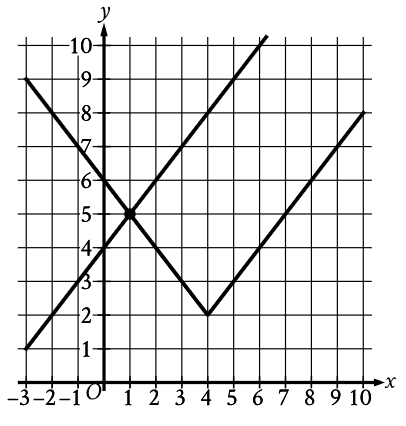
Question: The graph of a system of an absolute value function and a linear function is shown. What is the solution to this system of two equations?
A) (-1, 5)
B) (0, 4)
C) (1, 5)
D) (4, 2)
1️⃣ Explain the Question
~ A solution to a system is the intersection point
~ The point must lie on both graphs
~ You must read the exact intersection from the graph
2️⃣ Rules / Concepts Used
System of Equations (Graphical)
~ Each solution = point where graphs cross
~ Only one intersection is shown
~ (x, y): It is absolute.
3️⃣ Step-by-Step Graph Analysis
From the image:
~ The absolute value graph forms a “V”
~ The linear graph crosses it at exactly one point
~ That intersection is clearly at:
✅ Correct Answer: Option C
❌ (-1, 5) → Lies on one graph, not both
❌ (0, 4) → On the line but not on the V
❌ (4, 2) → Vertex of V but no line there
3rd Question
Question:
Which of the following is a factor of the polynomial above?
A)
B)
C)
D)
🧠 Core Concept (Recognize structure first)
This matches:
🧮 Step-by-Step Solution
Step 1: Arrange into Formula
We have:
then what is
then what is
then its expanded form is
Rewrite:
✅ Correct Answer: B
a + b ❌
Trap: Student ignores coefficients.
4a + 5b ❌
Trap: Student partially factors.
4a + 5b ❌
Trap: Student partially factors.
🧮 DESMOS
1. Type: factor(4a^2 + 20ab + 25b^2)
2. Output: (2a + 5b)^2
4th Question
| Data Value | Frequency |
|---|---|
| 6 | 3 |
| 7 | 3 |
| 8 | 8 |
| 9 | 8 |
| 10 | 9 |
| 11 | 16 |
| 12 | 9 |
| 13 | 0 |
| 14 | 6 |
Question: The frequency table summarizes the 57 data values in a data set. What is the maximum data value in the data set?
A) 11
B) 12
C) 14
D) 16
Important Rule
The maximum data value is:
The largest data value with a nonzero frequency
Step-by-Step Solution
| Data Value | Frequency |
|---|---|
| 6 | 3 |
| 7 | 3 |
| 8 | 8 |
| 9 | 8 |
| 10 | 9 |
| 11 | 16 |
| 12 | 9 |
| 13 | 0 ❌ |
| 14 | 6 ✅ |
We just need to know the Largest Data Value, we do not need to multiply Data Value to its Frequency to find out the largest. Just choose the Largest Data Value.
Data value 14 has frequency 6
Correct Answer
✅ Option: 14
Why Other Options Are Incorrect
11 ❌ Not the largest value
12 ❌ Still smaller than 14
16 ❌ This is a frequency, not a data value
Common Student Mistakes
❌ Confusing “how many” with “what value”
❌ Choosing the largest frequency
❌ Ignoring zero frequency
5th Question
Question: The measure of angle is radians. The measure of angle is radians greater than the measure of angle . What is the measure of angle , in degrees?
A) 75
B) 120
C) 195
D) 390
Understanding the Question
You are given:
Angle R in radians
Angle T is greater than R by a given radian amount
You must convert the final angle into degrees.
Important Rules
Add radians first
Convert radians → degrees using:
Step-by-Step Solution
Step 1: Given ValuesT is greater than R, so
Step 2: Add the Radians
Find a common denominator between 3 and 12 LCM:
Step 3: Convert to DegreesDivide 180 by 12
Correct Answer: Option C
Why Other Options Are Incorrect
75° ❌ Too small, ignores addition
120° ❌ Equals , not T
390° ❌ Arithmetic error
Common Student Mistakes
Dropping π incorrectly
Converting before adding
Forgetting common denominators
Use DESMOS as a calculator only.
6th Question
Question:
What values satisfy the equation?
A) and
B) and
C) and
D) and
🧠 Core Concept (Why quadratic formula is needed)
This quadratic:
~ does not factor nicely
~ coefficients are small but roots involve irrational numbers
So the quadratic formula is the correct and safest method.
🧮 Step-by-Step Solution
Quadratic formula:
Identify coefficients:
Step 1: Compute the discriminant
~ Minus, Minus = Plus, so
~ Same here =
Step 2: Substitute into the formula
Let’s input the already calculate part:
Now, let’s input other values:
So the solutions are:
✅ Correct Answer: C
Option A ❌
Trap: Student guesses integer roots without checking.
Option B ❌
Trap: Student forces rational roots that don’t satisfy the equation.
Option D ❌
Trap: Student forgets that , not −1.
Desmos Steps
1. Desmos don’t get , so it will show nothing: a^2 – a – 1 = 0
2. But it gets x and y
3. Enter: x^2 – x – 1
4. Desmos will graph this equation on the coordinate plane ( on x-axis, y = 0 line).
5. Graph shows:
~ In Desmos, click on the intersection points where the graph crosses the x-axis.
~ (1.61803, 0) = (x, y)
~ (-0.61803, 0) = (x, y)
~ we know, in Desmos, we replace a to x
6. Now solve all options one-by-one to match the intersection points
7. Write options exactly like this – for example Option C
~ 1+ sqrt5 = it gives this 3.2360679775
~ copy it and paste it separate line then type: /2
~ 3.2360679775/2
~ You will get 1.61803…
~ That means it is correct, same step 7 – do it for 1-sqrt5
The intersect points match to Option C, done.
7th Question
Question: If and , what is the value of ?
A) 4
B) 6
C) 24
D) 96
Important Algebra Rule
If two fractions are equal:
you can substitute or simplify using known ratios.
Step-by-Step Solution
Step 1: Use the first equation
Step 2: Substitute into the second equation
Replace :
Step 3: Simplify
Cancel :
Step 4: Solve for n
Correct Answer
✅ Option: 24
Why Other Options Are Incorrect
4 ❌ Too small, doesn’t balance equation
6 ❌ Arithmetic mismatch
96 ❌ Forgot to divide by 4
Common Student Mistakes
❌ Cancelling incorrectly
❌ Forgetting substitution
❌ Solving too early
Desmos Verification
1. Type: x/y = 4
2. Type in 2nd line: 24x/ny = 4
3. Desmos will create a graph line.
4. Desmos asks to add a slider or inform the value of n
5. Enter: n value from options one-by-one
6. When you enter n = 24, notice that the question equation graph line and Option C graph line, matches exactly. It overlaps the question graph line.
That is your answer.
8th Question
| 0 | -2 |
| 2 | 4 |
| 6 | 16 |
Question: Some values of the linear function are shown in the table above. What is the value of ?
A) 6
B) 7
C) 8
D) 9
🧠 Core Concept (Why slope matters)
The question explicitly says linear function.
That tells us one critical fact:
~ The rate of change (slope) is constant everywhere.
So if we find the slope once, we can find any missing value, including .
This table is not about random values.
Each pair represents a point on the graph of the function:
~ When , → point (0, −2)
~ When , → point (2, 4)
~ When , → point (6, 16)
So we are not inventing anything like “, ”.
~ Since it is Math, we can assume point as .
~ Like
We are simply using the definition of a function:
~ A function assigns one output to each input
🧮 Step-by-Step Solution
Step 1: Find the slope using two points
Using and :
~
~
Slope formula:
or
Use any two points from the table (because the function is linear).
So the function increases by 3 units in output for every 1 unit increase in x.
Step 3: What the Slope Means Here (Concept Check)
Slope means:
~ Increase by 1 → increases by 3
~ Increase by 2 → increases by 6
This interpretation is essential for the next step.
Step 4: Move From a Known Value to
We already know:
We want:
That is an increase of 1 in .
Since slope = 3:
✅ Correct Answer: B) 7
Option A: 6 ❌
Trap: Student assumes slope = 2 instead of 3
(They divide incorrectly or eyeball the table)
Option C: 8 ❌
Trap: Student adds 4 (confuses output difference with input jump)
Option D: 9 ❌
Trap: Student multiplies slope by instead of applying change
🧮 Desmos Confirmation (Not the Reasoning)
1. Open Desmos
2. Enter a Table (This is critical)
~ In Desmos, click “+” → Table, then enter: [Don’t try to change y into f(x)]
x y
0 -2
2 4
6 16
👉 Desmos will automatically plot the points.
3. Use Linear Regression (Best SAT Trick)
~ In a new expression line, type exactly: y1 ~ mx1 + b
Desmos will output values for:
So Desmos confirms:
4. Evaluate Directly in Desmos: f(3) = 3(3) – 2
Desmon outputs: 7
9th Question
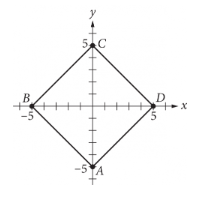
Question: In the -plane shown, square has its diagonals on the – and -axes. What is the area, in square units, of the square?
A) 20
B) 25
C) 50
D) 100
Understanding the Diagram
Square ABCD
Diagonals lie on x- and y-axes
The square is centered at the origin
Coordinates shown:
~ Top point at (0, 5)
~ Right point at (5, 0)
~ Bottom point at (0, –5)
~ Left point at (–5, 0)
Key Geometry Rule
For a square:
Diagonal length
Side length:
Area:
Step-by-Step Solution
Step 1: Length of Diagonal
From (0,5) to (0,–5):
Step 2: Side Length
Step 3: Area
OR
Correct Answer: Option C
Why Other Options Are Incorrect
20 ❌ too small
25 ❌ forgot diagonal relationship
100 ❌ squared diagonal incorrectly
Common Student Traps
Forgetting the √2 factor
Treating diagonal as side
Use DESMOS as a calculator.
10th Question
Question: If and , which of the following is equal to ?
A)
B)
C)
D)
Important Algebra Rules
1. Difference of squares:
2. Square a binomial:
Step-by-Step Solution
Step 1: Substitute
Simplify:
Step 2: Square: We have found but the question asked
So, we put a square on b – c
Expand: Binominal formula
Correct Answer
✅ Option B
Why Other Options Are Incorrect
Option A: uses , but cancels out
Option C: introduces extra terms not present
Option D: invalid algebraic structure
Common Student Mistakes
❌ Expanding before simplifying
❌ Forgetting cancellation of
❌ Squaring incorrectly
DESMOS TRICKS
1. Assign values to a, b, and c.
a = 1
b = 2
c = 3
~ You can assign any values.
2. Simplify: You must simplify it yourself to this point – take reference from above solution.
~ Type:
~~ No
(x^2 – y^2)^2 ❌
((a + b) – (a + c))^2 ❌
~~ Yes
((1 + 2) – (1 + 3))^2 ✅
~ Output: 1
3. Type options values one-by-one:
~ Option B: 2^2 – 2*2*3 + 3^2
~ Output: 1
Option B and question equation matches the output.
11th Question
Question: Line 𝓁 is defined by 3y + 12x = 5. Line n is perpendicular to line 𝓁 in the xy-plane. What is the slope of line n?
[Type-Based Answer: In the final exam, you will type the answer rather than choose from options.]
1/4 or 0.25 is correct.
🧮 Step-by-Step Correct Solution
The question asks for the slope of line n, but line is not given directly. Instead, we are told an important relationship: line n is perpendicular to line ℓ.
That means the first necessary step is to find the slope of line ℓ.
Without knowing the slope of line , we cannot determine the slope of a line perpendicular to it.
Step 1: Rewrite the given equation in slope form
Given:
To identify the slope, we need the equation in slope–intercept form:
This form is essential because:
~ The coefficient of (the number multiplying ) is by definition the slope
~ Slope is not directly visible unless the equation is written with y alone on one side
We do not isolate x because:
~ The standard slope formula used in SAT is taken from
~ Isolating x would require extra conversion later and hides the slope
So we isolate y deliberately to expose the slope clearly.
Subtract from both sides:
Now divide every term by 3:
Step 2: Identify the slope of line
From:
The slope of line is:
This value is critical — everything that follows depends on it.
Step 3: Why perpendicular lines use negative reciprocals
A key SAT rule applies here: If two lines are perpendicular, the product of their slopes is −1
Mathematically:
This rule comes from coordinate geometry and is always used on SAT when:
~ The word perpendicular appears
~ Slopes are involved
Step 4: Find the slope of line
We already know:
Apply the perpendicular-slope rule:
Solve for :
That means:
This process is often described as taking the negative reciprocal:
~ Reciprocal of →
~ Change the sign →
✔ This is the slope of line
✔ Divide 1 by 4 and you will get 0.25
✔ So either 0.25 or 1/4 is the correct answer
❌ Trap 1: Answer = −4
Why students choose this:
~ They stop after finding the slope of line
~ They forget the question asks for the slope of line n
Mistake:
~ Ignoring the word perpendicular
~ ❌ Trap 1: Answer = −4
Why students choose this:
~ They stop after finding the slope of line
~ They forget the question asks for the slope of line n
Mistake:
~ Ignoring the word perpendicular
~ Confusing “opposite slope” with “perpendicular slope”
❌ Trap 2: Answer = −1/4 or -0.25
Why students choose this:
~ They correctly take the reciprocal
~ They forget to change the sign
Mistake: Incomplete application of the negative-reciprocal rule
🧮 DESMOS CALCULATOR — VERIFICATION METHOD
Step-by-Step in Desmos
1. Open Desmos
2. In Expression Line 1, type: y = -4x + 5/3
(This is line )
3. In Expression Line 2, type: y = (1/4)x
(This represents a line with slope )
4. Zoom in near the intersection
5. Observe:
~ Lines intersect at a right angle
~ Confirms perpendicularity
✔ Confirms slope =
12th Question
Question: Percent of Residents Who Earned a Bachelor’s Degree or Higher
| State | Percent of residents |
|---|---|
| State A | 21.9% |
| State B | 27.9% |
| State C | 25.9% |
| State D | 19.5% |
| State E | 30.1% |
| State F | 36.4% |
| State G | 35.5% |
A survey was given to residents of all 50 states asking if they had earned a bachelor’s degree or higher. The results from 7 of the states are given in the table above. The median percent of residents who earned a bachelor’s degree or higher for all 50 states was 26.95%. What is the difference between the median percent of residents who earned a bachelor’s degree or higher for these 7 states and the median for all 50 states?
A) 0.05%
B) 0.95%
C) 1.22%
D) 7.45%
Understanding the Question
You are given percentages from 7 states and told that the median for all 50 states is 26.95%.
You must:
~ Find the median of the 7 given values
~ Find the difference between the two medians
Key Rule (Median)
~ The median is the middle value when data is arranged in ascending order
~ For 7 numbers, the median is the 4th number
Step-by-Step Solution
Step 1: List the percentages in ascending order
19.5, 21.9, 25.9, 27.9, 30.1, 35.5, 36.4
Step 2: Identify the median of the 7 states
4th value = 27.9%
Step 3: Compare with the national median
National median = 26.95%
Step 4: Find the difference
✅ Correct Answer: 0.95%
❌ Why the Other Options Are Wrong
7.45% → comparing max and min, not medians
0.05% → subtracting the wrong values
1.22% → difference between wrong middle values
Use DESMOS only a calculator.
13th Question
Question: An oceanographer uses the equation to model the speed , in knots, of an ocean wave, where represents the period of the wave, in seconds. Which of the following represents the period of the wave in terms of the speed of the wave?
A)
B)
C)
D)
Understand the Question
Problem (understanding the question)
Given:
Where:
= speed (knots)
= period (seconds)
Asked:
👉 Express p in terms of s
Important Rule
To solve for a variable: Undo multiplication using division
Step-by-Step Solution
Multiply both sides by :
Rewriting:
Or
There is another mathematical way:
We need to find p
Numerator goes on divide of another side.
Denominator / value in divide goes another side as multiply
So:
Correct Answer
✅ Option A
Why Other Options Are Incorrect
Option B: keeps the same multiplier — no rearranging
Option C & D: add instead of multiply — violates algebra rules
Common Student Mistakes
❌ Switching variables without isolating
❌ Adding instead of dividing
❌ Forgetting inverse operations
14th Question

Question: In the figure shown, points , and lie on line segment , and line segment intersects line segment at point . The measure of is , the measure of is , the measure of is , and the measure of is . What is the measure, in degrees, of ?
A) 123
B) 134
C) 145
D) 156
✅ Understand the QUESTION — Multi-Triangle Angle Chase
Given
~ Points lie on straight line
~ Lines intersect at
~ Given angle measures:
Find
1️⃣ Key Geometry Rules
📌 Triangle Sum Rule
📌 Linear Pair Rule
Angles on a straight line sum to:
📌 Vertical Angles
Vertical angles are equal
2️⃣ Step-by-Step Logic
🔹 Step 1: What we have and what we need to find:
Find , to find out , we need and .
~ To find , we have given .
~ To find , we need to find .
~ To find we need to find and .
~ ~ To find , we have given .
~ ~ To find , we need to find .
~ ~ ~ To find , we have given and .
It looks difficult but actually, there are only 3-Key rules here. Once you master this type of Questions. All problems from Line, Angle, and Triangles will be easy for you.
🔹 Step 2: Find :
We use Triangle Sum Rule because , and are angles of one triangle,
So
🔹 Step 3: Find :
Look at the figure, notice that and are on the same vertical angle. Look at the point on both,
So
🔹 Step 4: Find :
Notice on the figure that and are a linear pair. Look at the points and ,
So
🔹 Step 5: Find :
We use Triangle Sum Rule because , and are angles of one triangle,
So
🔹 Step 6: Find :
Look at the figure, notice that and are on the same vertical angle. Look at the point on both,
So
🔹 Step 7: Find :
Notice on the figure that and are a linear pair. Look at the points and ,
So
🔹 Step 8: The Final Part – Find :
We use Triangle Sum Rule because , and are angles of one triangle,
So
✅ Correct Answer is 123: Option A
❌ 134 / 145 → missing vertical angle transfer
❌ 156 → assuming straight-line angle instead of triangle sum
🧮 Desmos?
🚫 Not suitable — requires angle inference, not coordinates.
15th Question
Question: A certain apprentice has enrolled in 85 hours of training courses. The equation 10x + 15y = 85 represents this situation, where x is the number of on-site training courses and y is the number of online training courses this apprentice has enrolled in. How many more hours does each online training course take than each on-site training course?
[Type-Based Answer: In the final exam, you will type the answer rather than choose from options.]
🧮 Step-by-Step Solution
This equation represents total training hours, not the number of courses.
Each term follows the structure:
From the equation: 10x + 15y = 85
~ x represents on-site course
~ 10x → each on-site course takes 10 hours
~ y represents online course
~ 15y → each online course takes 15 hours
The question does not ask for or .
It asks for the difference in hours per course. (Key word: How many more)
So we compare the coefficients directly.
Step: Compare course durations
(A real trap in question if you do not understand or read it properly. Those who miss that try to solve the equation but that is not what the question asks here. It asks:
How many more hours does each online training course take than each on-site training course?
~ It did not ask “How many more number of courses?”
~ It asks “How many more hours of online training course?”
✅ Correct Answer: 5 hours
❌ Trap 1: Answer = 85
Why students choose this:
They confuse total hours with difference per course.
❌ Trap 2: Answer = 25
Why students choose this:
They add the coefficients instead of comparing them:
❌ Trap 3: Answer = 1.5
Why students choose this:
They divide coefficients instead of subtracting:
🧮 DESMOS CONFIRMATION
1. Open Desmos
2. Type: 10x + 15y = 85
3. Observe coefficients directly — they represent hours per course
✔ Confirms difference is 5 hours
16th Question
Question:
How many distinct real solutions does the given equation have?
A) Exactly one
B) Exactly two
C) Infinitely many
D) Zero
🔑 Key Algebra Rule
The square of any real number is never negative
🧠 Step-by-Step Solution
Left side:
Right side:
A nonnegative number cannot equal a negative number.
So:
has no real solution.
✅ Correct Answer – Option D : Zero
❌ Why Other Options Are Incorrect
Infinitely many ❌ false
Exactly one ❌ impossible
Exactly two ❌ no real roots
17th Question
Question:
The equation above is true for all , where and are constants. What is the value of ?
A) 18
B) 20
C) 24
D) 40
1️⃣ What the Question Is Testing
This is polynomial identity matching.
When two polynomials are equal for all x:
👉 Coefficients of like powers of x must be equal
This is not solving for x, this is comparing coefficients.
2️⃣ Step-by-Step Expansion
Expand the left side carefully.
Distribute term by term:
Multiply by
Multiply by
3️⃣ Combine Like Terms
4️⃣ Match with the Right Side
Right side:
Now match power by power:
Now solve it using matching values / figures.
terms:
Remove from both sides:
terms:
Remove from both sides:
Remove negative from both sides:
We already have the value. We know ab, so we do not need to calculate anymore, but if it is something else, this is how you proceed.
✅ Correct Answer: Option C
• 18 / 20 → students forget to include +15 from distribution
• 40 → students match only and multiply randomly
• SAT loves coefficient-matching traps
Use Desmos as a calculator only for this one.
18th Question
Question: A manufacturing plant makes 10-inch, 9-inch, and 7-inch frying pans. During a certain day, the number of 10-inch frying pans that the manufacturing plant makes is 4 times the number n of 9-inch frying pans it makes, and the number of 7-inch frying pans it makes is 10. During this day, the manufacturing plant makes 100 frying pans total. Which equation represents this situation?
A)
B)
C)
D)
Understand the Question
Problem (understanding the situation)
A manufacturing plant makes three sizes of frying pans:
10-inch pans
9-inch pans
7-inch pans
Given:
Number of 9-inch pans = n
Number of 10-inch pans = 4n
Number of 7-inch pans = 10
Total pans made = 100
The question asks:
👉 Which equation correctly represents this situation?
Important Concept / Rule
This is a word-to-equation translation problem.
Key idea: When counting objects, we add the number of objects, not their sizes.
⚠️ The inches (10-inch, 9-inch, 7-inch) are labels, NOT values to multiply.
Step-by-Step Construction of the Equation
10-inch pans → 4n pans
9-inch pans → n pans
7-inch pans → 10 pans
Total pans:
Simplify:
Correct Answer:✅ Option D
Why Other Options Are Incorrect
Option A:
❌ Incorrectly multiplies pan size with quantity
Pan size does NOT affect the count
Option B:
❌ Assumes all quantities are proportional to size — false
Option C:
❌ Ignores the n 9-inch pans
Common Student Mistakes
❌ Multiplying by pan sizes
❌ Forgetting one category
❌ Treating inches as quantities
19th Question
Question: Near the end of a US cable news show, the host invited viewers to respond to a poll on the show’s website that asked, “Do you support the new federal policy discussed during the show?” At the end of the show, the host reported that 28% responded “Yes,” and 70% responded “No.” Which of the following best explains why the results are unlikely to represent the sentiments of the population of the United States?
A) The percentages do not add up to 100%, so any possible conclusions from the poll are invalid.
B) Those who responded to the poll were not a random sample of the population of the United States.
C) There were not 50% “Yes” responses and 50% “No” responses.
D) The show did not allow viewers enough time to respond to the poll.
🔑 Key Statistical Concept
This is a sampling bias question.
A valid survey requires:
~ Random selection
~ Equal chance for all members of the population to respond
🧠 Step-by-Step Explanation
The poll was taken from viewers of one cable news show
Only people who:
~ Watch that show
~ Visit the website
~ Choose to respond
were included
This means the sample:
~ Is self-selected
~ Is not random
~ Likely reflects opinions of a specific audience, not the US population
✅ Correct Answer
B) Those who responded to the poll were not a random sample of the population of the United States.
❌ Why Other Options Are Incorrect
Option A
❌ Percentages not totaling 100% could be rounding — not the main issue.
Option C
❌ Surveys do not need 50–50 results to be valid.
Option D
❌ Time allowed does not fix sampling bias.
20th Question
Question:
In the given system of equations, and are constants. The graphs of these equations in the xy-plane intersect at the point (4, y). What is the value of ?
A) 14
B) 6
C) 4
D) 3
Choice A is correct.
🧮 Step-by-Step Solution
~ xy-plane (x, y) = (4, y)
~ Because the point of intersection is ,
~ both equations must be true when x = 4.
That is the key instruction hidden in the question.
Step 1: Substitute into the first equation
Rearrange:
Step 2: Substitute into the second equation
Subtract 24:
Divide by 2:
Step 3: Equate the two expressions for
From above:
Solve:
✅ Correct Answer: A) 14
Option B: 6 ❌
Trap: Student divides 56 by 4 directly, ignoring system structure.
Option C: 4 ❌
Trap: Student confuses with .
Option D: 3 ❌
Trap: Student divides 12 by 4 after incorrect simplification.
🧮 DESMOS CONFIRMATION
1. Open Desmos
2. Enter:
ax + by = 72
6x + 2by = 56
3. Substitute and test values of
4. Only a = 14 gives a common intersection point
✔ Confirmed
21th Question
Question: The product of two positive integers is 462. If the first integer is 5 greater than twice the second integer, what is the smaller of the two integers?
[Type-Based Answer: In the final exam, you will type the answer rather than choose from options.]
🔹 Understand the QUESTION
Given
~ The product of two positive integers is 462
~ The first integer is 5 greater than twice the second integer
~ Find the smaller integer
🧠 STEP 1: DEFINE VARIABLES (WHY THIS SETUP)
There are two integers.
Let the second integer: The smaller integer =
Then the first integer is: Twice the second integer = with 5 greater
~ First integer =
This setup is chosen because:
~ SAT word problems always describe one quantity in terms of another
~ “5 greater than twice” means multiply first, then add
🧮 STEP 2: USE THE PRODUCT CONDITION
The product is 462, so: 2nd Integer(1st Integer) = Total
Expand:
Move everything to one side:
This step is necessary because:
~ Quadratic equations must be written in standard form to factor or solve
Method 1:
For quadratic, we need to prepare these first:
we will turn b into this then to
After that just simplify it:
, so the best values suit here are (-28 + 33) = 5
Here is a twist the value c made out of 2 integer, so must be product of 2c:
, so
Now, let’s put it all together:
| Formula side | Actual Solving |
|---|---|
| Expand | |
| – | |
| Rewrite to make Common | |
| Common value out |
Factor the equation:
then then then
then then
So:
Method 2:
The formula:
Put values:
this sign means, we can do either plus or minus, so:
or
or
or
Both Method 1 and 2 are correct, choose according to your choice.
🚫 STEP 3: APPLY CONTEXT RESTRICTIONS
The question states positive integers, so:
~ Fractions are not allowed
~ Negative values are not allowed
~ and we need a smaller integer
Thus:
Verifying:
1. Input x = 14 into the equation:
⚠️ COMMON TRAPS (REAL MISTAKES)
❌ Forgetting integers must be whole numbers
❌ Forgetting “twice” and writing
❌ Solving the quadratic but choosing the negative root
❌ Giving the larger integer instead of the smaller
🧮 DESMOS METHOD (REAL & VALID)
Step 1: Open Desmos
Type: x(2x + 5) = 462
Step 2: Convert to y-form
y = x(2x + 5) – 462
Step 3: Find x-intercepts
Desmos shows: Go to graph and only focus on x-axis
x ≈ −16.5
x = 14
Only 14 satisfies the conditions.
22th Question
Question: The function is defined by , where . What is the product of and ?
[Type-Based Answer: In the final exam, you will type the answer rather than choose from options.]
Given
Find:
✅ Step-by-Step Mathematical Solution
🔹 Step 1: Understand the key conditions
~ If , then:
and , it means
and
Recall the absolute value rule:
This condition controls how absolute value behaves.
u is just to demonstrate, you can replace it with a or anything else.
~ If , then:
and
So the in both inputs is a negative numbers.
🔹 Step 2: Evaluate
Start with the definition:
Absolute Value Handling (Critical Concept)
Since:
15 is positive
Then:
And because , we know:
So:
Substitute back:
Cancel (allowed since ):
🔹 Step 3: Evaluate
Same logic, new input:
Because :
So:
Cancel :
🔹 Step 4: Find the Product
✅ Final Answer: 609
❌ Trap 1: Treating 15a and 7a as “just a”
Wrong — they are inputs, not constants.
❌ Trap 2: Forgetting a < 0
If you assume a > 0, you will get completely wrong signs.
❌ Trap 3: Dropping absolute value incorrectly
Absolute value changes everything when negatives are involved.
🧮 REAL Desmos Method (Correct Usage Only)
This is how a student would actually verify the answer in Desmos.
Step 1: Define the function (using a slider)
1. Type: k(x) = abs(x)/a – 14
2. Create a slider for a and set:a = -1 (or any negative value)
~ It means, type any value the answer will come same here but it must be negative.
SAT allows this because the expression depends on sign, not magnitude.
Step 2: Evaluate the function values
1. In Desmos, type:
k(15a)
k(7a)
2. Desmos will display:
k(15a) = -29
k(7a) = -21
Step 3: Multiply directly
1. Type: k(15a) * k(7a)
or
just directly type: -29 * -21
2. Desmos output: 609
✅ Confirms the algebraic solution perfectly.
Did you try all the features and get comfortable using them? You should work on using the calculator and seeing references and directions. So be prepared for everything before taking the final SAT exam. The explanation of answers makes easier to learn and progress. You must try to work on your speed and spend less time on the beginning and more on the later questions. This is the SAT 2024 Practice Test of Math Module 2nd.
There are more tests available:
- SAT 2025 Test (Math Module 1st)
- SAT Test 3rd (Math Module 1st)
- SAT Test 6th (Reading and Writing Module 2nd)
The best way to become a master in Math is to find the correct answer and understand why other options are incorrect. I wish you luck in your bright career.