The SAT 2024 Examination Test (Math Module 2nd with Step-By-Step Solutions, Tips and Desmos Tricks
How was your Module 1st? How much score have you made? Please tell us in the comment. The SAT math seems tough without Desmos Calculator but we have solution for this. This test is a practice test of 2024 SAT Math Module Second. Here, you would see questions that were possible to be on 2024 examination. The best parts are:
- solutions of all questions,
- step-by-step explanations,
- how to verify the correct answer,
- description of correct and incorrect options,
- tips and tricks,
- and Desmos Calculator Hacks.
Like the other exams, it has the same format and all the necessary features for you to become a SAT master in math. You just take the Module 2nd exam to practice your skills. The best part is that you practice within the time limit, and there are explanations of answers, tips and tricks to get a perfect score on the SAT. You will find Math easy after this.
ABOUT THE SAT MODULES
The SAT is divided into four modules. There are two categories with each split into two modules. The first category is “Reading and Writing” with two modules. The second category is “Math” with two modules. The one, you will do below is SAT Math 2024 Practice Test Module 2nd.
The first module has questions ranging from easy to difficult, but the second module only contains medium to difficult questions, no easy. If you want to take some other SATs, visit the links below.
- 1st Module of SAT Reading And Writing Practice Tests
- 2nd Module of SAT Reading And Writing Practice Tests
- 1st Module of SAT Math Practice Tests
- 2nd Module of SAT Math Practice Tests
THE SAT MATH MODULE 2ND
The second module of Math in SAT contains four segments: “Algebra,’ ‘Advanced Math,’ ‘Problem-Solving and Data Analysis,’ and ‘Geometry and Trigonometry.” The questions in Module 2nd are from medium to difficult. In a real SAT exam, you must answer 22 questions within 35 minutes. We have provided you with the same in this Practice Test.
Instructions for the SAT Real-Time Exam: Tips Before Taking Tests
- Previous-and-Next: Like in real SAT exam, you can move freely from one question to another, same things you can do here. You select one option and move forward but you realized something, so you came back and change your option. You can do that here and in the real SAT exam too.
- Timer: On the top of the slide, you will see the timer, it starts from 0 and for Module 1st of Math you will get 35 minutes to finish 22 questions. Always try to finish the test before 35 minutes.
- Image: You can click on a graph, table, or other image to expand it and view it in full screen.
- Mobile: You cannot take the real exam on mobile, but our practice exam you can take on mobile phone.
- Calculator: Below the Test, you will see a Desmos calculator and graph for Math. The same, Desmos, will be used in real exams, so learn “How to use Desmos Calculator.”
- Answer All: Even if you do not know the correct answer of a question, still guess it because there is no Negative marking.
- Last Questions: The harder the question, the more marks it will fetch for you. So most likely, you will find later question difficult and more time-consuming, so utilize your time accordingly.
- Tips: This article will help you learn more about the SAT Exams. SAT: EVERYTHING ABOUT THE SAT
Wait for the Desmos Calculator to appear.
SAT MATH PROBLEM SOLUTIONS WITH STEP-BY-STEP EXPLANATION
Do not open the tabs before finishing the practice test above! For your convenience, we have compiled all the solutions and their explanations here. We will also give you some tips and advice to help you understand them better. You’ll see ‘why this answer is correct’ and ‘why this is incorrect.’
Math Solutions and Explanations:
The light red color shows the Question, green shows the Correct answer with step-by-step explanation, red shows the Incorrect one, and blue shows Desmos Tips or Tricks.
1st Question
Question: If , what if ?
A) -5
B) -2
C) 2
D) 5
1️⃣ Explain the Question (What is being asked)
~ You are given a rational function
~ You must substitute x = −1 into the function
~ Since the denominator is not zero at , direct substitution is allowed
3️⃣ Step-by-Step Solution
The questions says:
where
Substitute : All we need to do is to fill the value x.
Numerator:
Denominator:
Final value:
✅ Correct Answer: Option A
❌ -2 → Divided incorrectly
❌ 2 → Ignored sign of denominator
❌ 5 → Forgot denominator was negative
5️⃣ Desmos ACTUAL Trick
1. Type: f(x) = (x^2 – 6x + 3)/(x -1)
2. Type on the 2nd line: f(-1)
2. Desmos shows Output: -5
2nd Question
Question: A veterinarian recommends that each day a certain rabbit should eat 25 calories per pound of the rabbit’s weight, plus an additional 11 calories. Which equation represents this situation, where is the total number of calories the veterinarian recommends the rabbit should eat each day if the rabbit’s weight is pounds?
A)
B)
C)
D)
✅ Correct Answer: B)
🧮 Step-by-Step Correct Reasoning
The statement has three parts:
1. The weight is x and the 25 calory should be given according to weight, so we multiply.
2. 25 calories per pound →
3. Plus an additional 11 calories →
Combine both:
✔ Matches Option B exactly
❌ Option A:
Why students choose it:
They stop reading after: “25 calories per pound”
They ignore: “plus an additional 11 calories”
❌ Missing constant term
❌ Option C:
Why students choose it:
They incorrectly add:
But 11 is not per pound, it’s a fixed amount.
❌ Mixed unit mistake
❌ Option D:
Why students choose it:
They reverse roles:
~ Treat 11 as “per pound”
~ Treat 25 as constant
This directly contradicts the wording.
❌ Misreading variables
🧮 DESMOS CALCULATOR — QUICK CHECK
Step-by-Step
1. Open Desmos
2. Type: c = 25x + 11
3. Use the Table icon
4. Try :
~ Calories = 36
~ Matches: 25 + 11
✔ Confirms equation logic
3rd Question
Question:
For the function defined above, what is the value of ?
A) 9
B) 12
C) 18
D) 36
1️⃣ Explain the Question
~ This is an exponential function
~ You substitute
~ Exponents must be evaluated before multiplication
2️⃣ Formula / Rule Used
Order of Operations (PEMDAS)
Exponents → Multiplication
3️⃣ Step-by-Step Solution
We know , so
Substitute :
Calculate exponent:
Multiply:
✅ Correct Answer: Option C
❌ 9 → Forgot to multiply by 2
❌ 12 → Multiplied before exponent
❌ 36 → Squared 6 incorrectly
5️⃣ Desmos ACTUAL Trick
We know x = 2, so
1. Type: 2(3^2)
2. Output: 18
4th Question
Question: For the exponential function , the value of is , where is a constant. Of the following equations that define the function , which equation shows the value of as the coefficient or the base?
A)
B)
C)
D)
1️⃣ What the Question Is Really Testing
~ This is about the y-intercept of an exponential function
~ The y-intercept occurs when:
So:
is Constant and coefficient or the base value.
The question is asking:
In which equation is the value of already visible without doing extra exponent work?
2️⃣ Key Rule / Formula
For an exponential function:
When :
✅ The coefficient a equals the y-intercept
3️⃣ Step-by-Step Option Analysis
The question tells us that the value of
It gives us a clean hint that
But the most important hint is:
is Constant and coefficient or the base value.
~ In simple words, is the Initial value, so based on formula above:
~ : According to the formula, is the base value.
Overall what it means that the Base value is the Final value, so the solution is:
value is the answer.
Now look up the Options, which option do you consider stay remained?
Option B:
To Test – Substitute :
✅ The coefficient directly equals c
✔ No extra calculation needed
✔ or Base Value Remains the same at last
✔ and
Option A
Substitute :
❌ The value of is not shown directly
❌ and are not the same or Base Value doesn’t remain the same at last.
❌ and .
Option C
Substitute :
❌ The value of is not shown directly
❌ and are not the same or Base Value doesn’t remain the same at last.
❌ and .
Option D
Substitute :
❌ The value of is not shown directly
❌ and are not the same or Base Value doesn’t remain the same at last.
❌ and .
Use Desmos as a calculator for this.
5th Question
Question: Which of the following expressions is equivalent to ?
A)
B)
C)
D)
1️⃣ Explain the Question (Interpretation)
~ You are given a polynomial with three terms
~ The question asks for an equivalent expression
~ This usually means factoring, not expanding
~ Look for a common factor across all terms
2️⃣ Formula / Rule Used
Greatest Common Factor (GCF)
If all terms share a factor, factor it out:
3️⃣ Step-by-Step Solution
Given:
Step 1: Find the GCF
Coefficients: 8x10 – 8x9 + 88x
GCF of 8, 8, 88 → 8
Variables: smallest power of → x
So GCF = 8x
Step 2: Factor out 8x
Final factored form:
✅ Correct Answer: Option D
❌ Option A:
~ Coefficients are changed incorrectly
~ Factoring never changes values
❌ Option B:
~ Powers are wrongly applied to 8 instead of x
~ Completely different expression
❌ Option C:
~ Incorrect division while factoring
~ Inside powers increase instead of decrease
5️⃣ Desmos ACTUAL Trick
1. Type the question equation: 8x^10 – 8x^9 + 88x
2. Check the graph: You will see line.
3. Type Options one-by-one in different lines.
4. Observe:
~ Both Question and Option D overlaps perfectly. They are on the same track.
That confirms our correct option.
6th Question
Question:
𝑦 = 2𝑥 + 10
𝑦 = 2𝑥 − 1
At how many points do the graphs of the given equations intersect in the xy-plane?
A) Zero
B) Exactly one
C) Exactly two
D) Infinitely many
🧠 Core Concept Used
Lines intersect once if slopes are different
Lines never intersect if:
~ Slopes are the same
~ Intercepts are different
🧮 Step-by-Step Solution
The formula:
Step 1: Compare slopes
Both equations have slope:
So the lines are parallel.
Step 2: Compare y-intercepts
First line:
Second line:
Different intercepts → different lines
Step 3: Conclusion
Parallel lines never intersect.
✅ Correct Answer: Zero
Option B: Exactly one ❌
Trap: Student assumes all linear systems intersect once.
Option C: Exactly two ❌
Trap: Student confuses with quadratic intersections.
Option D: Infinitely many ❌
Trap: Would only occur if equations were identical.
🧮 Desmos Confirmation
Plot:
y = 2x + 10
y = 2x – 1
✔ Parallel lines, no crossing
7th Question
Question: The expression is equivalent to , where is a constant. What is the value of ?
A) 6
B) 9
C) 15
D) 90
1️⃣ What the Question Is Testing
~ This is factoring
~ You must match coefficients
~ The structure:
~
2️⃣ Step-by-Step Factoring
Start with:
Factor out the greatest common factor:
~ GCF of 90 and 54 → 18
~ Lowest power of →
Now rewrite the given expression:
Factor inside:
So:
3️⃣ Match the Coefficients
From factoring:
From rewritten form:
So:
Solve:
✅ Correct Answer: Option A
Choice B is incorrect and may result from conceptual or calculation errors.
Choice C is incorrect and may result from conceptual or calculation errors.
Choice D is incorrect and may result from conceptual or calculation errors.
🧮 Desmos Trick
1. Type: x = 90y^5 – 54y^4
2. Do not directly type: ry^4(15y – 9)
3. What we need to do is to put value of :
~ The options are values of
~ So replace it with 6, 9, 15, 90.
~ Type in 2nd line like this: x = 6y^4(15y – 9)
4. Observe:
~ The graph lines overlap – confirms correctness of the Option.
8th Question
Question: A rectangular volleyball court has an area of 162 square meters. If the length of the court is twice the width, what is the width of the court, in meters?
A) 9
B) 18
C) 27
D) 54
1️⃣ Explain the Question
~ Rectangle area is given
~ Relationship between length and width is given
~ We are solving for width
~ This is a systems / substitution word problem
2️⃣ Formula / Rule Used
Area of a Rectangle
Area of Rectangle:
Length =
Width =
3️⃣ Step-by-Step Solution
Let:
~ Width =
~ Length = (Question told: If the length is twice the width)
Substitute into area formula:
We know that
Divide by 2 both sides or just move 2 to left-hand side in divide position:
Take square root:
✅ Correct Answer: Option A
❌ 18: Student forgot to square root
❌ 27: Multiplied instead of solving
❌ 54: Treated area as perimeter
5️⃣ Desmos ACTUAL Trick
1. Type in Desmos: 2w^2 = 162
2. Desmos solves: w = 9
But if you want to see visually in graph then
1. Type: y = 2x^2
2. Type in 2nd line: y = 162
3. Observe: The graph Intersection at x = 9.
9th Question
Question: In right triangle , the sum of the measures of angle and angle is 90 degrees. The value of is . What is the value of ?
A)
B)
C)
D)
✅ Understand the QUESTION
Trigonometry: Complementary Angles
Given:
~ Triangle RST is a right triangle
That means R and S are complementary angles
Asked:
Find
🧠 Key Trigonometry Rule
In a right triangle:
Since:
Go back to the definitions (this is the real “why”)
In a right triangle:
Now look at angles R and S:
What is opposite to R → is adjacent to S
What is adjacent to R → is opposite to S
So the same two sides are used — just swapped roles.
That’s why:
Step 1: Core Trigonometric Rule Used
For complementary angles in a right triangle:
~ Let’s understand why are the same.
~ The question tells us:
~ That means , and
So: and
That is why:
→ ,
so →
Do you get is now? For knowledge, you can check sin(S) too.
→ ,
so →
We know now that
✏️ Apply the Rule to Understand
Look above “Go back to definition” part to better understand, why they are the same.
Direct complementary-angle identity.
Option B is correct.
If you are still not satisfied, take a Practical Visual Desmos test to understand better.
Option A:
Wrong ratio; unnecessary simplification.
Option C:
Reciprocal mistake.
Option D:
Trigonometric values must be ≤ 1.
📌 Concept Reminder
Sine of one acute angle equals cosine of the other in right triangles.
DESMOS Tricks
1. Type in one line: sin(x)
2. Type in second line: cos(90-x)
3. Observe:
~ The graphs overlap exactly
~ This visually proves: sin(R) = cos(S)
10th Question
Question: The pressure exerted on a scuba diver at sea level is 14.70 pounds per square inch (psi). For each foot the scuba diver descends below sea level, the pressure exerted on the scuba diver increases by 0.44 psi. What is the total pressure, in psi, exerted on the scuba diver at 105 feet below sea level?
A) 60.90
B) 31.50
C) 14.70
D) 0.44
🧠 Core Concept (Why this is a linear model)
This situation has:
~ a starting value (pressure at sea level)
~ a constant rate of increase per foot
So we model it using:
Choice B is correct.
🧮 Step-by-Step Solution
Step 1: Identify known values
~ Initial pressure = 14.70 psi
~ Rate of increase = 0.44 psi per foot
~ Depth = 105 feet
Step 2: Calculate pressure increase due to depth
This step is necessary because the increase happens every foot, not once: (Rate) (Depth)
This is the additional pressure caused by going down 105 feet.
Step 3: Add sea-level pressure (Initial)
The diver already experiences pressure at sea level, so we must add it.
✅ Correct Answer: A) 60.90
Option B: 31.50 ❌
Trap: Student multiplies incorrectly or uses half the depth.
Option C: 14.70 ❌
Trap: Student ignores depth entirely.
Option D: 0.44 ❌
Trap: Student mistakes rate for total pressure.
🧮 Desmos Confirmation
Type: 14.7 + 0.44(105)
✔ Output = 60.9
11th Question
Question:
The function above models the annual salary, in dollars, of an employee years after starting a job, where is a constant. If the employee’s salary increases by 4% each year, what is the value of ?
A) 0.04
B) 0.4
C) 1.04
D) 1.4
1️⃣ Explain the Question
~ This is an exponential growth model
~ represents the growth factor
~ A percent increase must be converted correctly
2️⃣ Formula / Rule Used
The main formula:
But the question only asked to find growth, so:
Growth Factor Rule
If something increases by :
is 4% or
3️⃣ Step-by-Step Solution
Given:
~ Increase = 4%
~ Convert percent to decimal:
Apply rule:
✅ Correct Answer: Option C
❌ 0.04: Student forgot to add 1
❌ 0.4: Miscalculated percentage and forgot to add 1
❌ 1.4: Miscalculated percentage
Use DESMOS as a calculator for this.
12th Question
Question: Which of the following is an equivalent form of ?
A)
B)
C)
D)
1️⃣ Key Algebra Rules Used
Square a binomial
~ Distribute negative sign
~ Combine like terms
2️⃣ Step-by-Step Expansion
Step 1: Square the binomial
Step 2: Subtract the second expression
Step 3: Combine like terms:
Final expression:
✅ Correct Answer: Option C
Choice A is incorrect and may result from conceptual or calculation errors.
Choice B is incorrect and may result from conceptual or calculation errors.
Choice D is incorrect and may result from conceptual or calculation errors.
🧮 Desmos Trick
1. Type: y = (1.5x – 2.4)^2 – (5.2x^2 – 6.4)
2. Type from 2nd line all options one-by-one: y = -2.95x^2 – 7.2x + 12.16
3. Observe:
~ The graph lines overlap – confirms correctness of the Option.
13th Question
Question: Square X has a side length of 12 centimeters. The perimeter of square Y is 2 times the perimeter of square X. What is the length, in centimeters, of one side of square Y?
A) 6
B) 10
C) 14
D) 24
✅ Understand the QUESTION
Perimeter of Squares
Given:
~ Square X has side length = 12 cm
~ Perimeter of square Y, 2 times X = 2 × perimeter of square X
Asked:
Side length of square Y
🧠 Key Geometry Formula
✏️ Step-by-Step Solution
Step 1: Perimeter of square X: 4 × side
4 × 12 = 48
Step 2: Perimeter of square Y: 2 × Square X
2 × 48 = 96
Step 3: Side of square Y:
A Square has 4 sides, so we divide it by 4 to get one side.
96 ÷ 4 = 24
✅ Correct Answer: Option D
6 ❌
Directly divide 12 by 2, don’t do it.
10 ❌
Directly subtract 2 from 12.
14 ❌
Directly add 2 to 12.
DESMOS Tricks
It is better to just use Desmos as a calculator for this one.
14th Question
Question: The function is defined by . What is the x-intercept of the graph of in the xy-plane?
A) (-12, 0)
B) (-7, 0)
C) (7, 0)
D) (12, 0)
🧠 Core Concept (Why x-intercept means this)
The x-intercept is the point where: Take reference from options (x, y)
So we must set the function equal to zero.
🧮 Step-by-Step Solution
Step 1: Set
Step 2: Solve for
Move add to right-hand side, which changes its sign from negative to positive:
Divide by 7:
Step 3: Write as an ordered pair
✅ Correct Answer: D) (12, 0)
Option A: (-12, 0) ❌
Trap: Student moves 84 to the wrong side and changes sign incorrectly.
Option B: (-7, 0) ❌
Trap: Student divides 84 by 12 instead of 7.
Option C: (7, 0) ❌
Trap: Student confuses coefficient with solution.
🧮 Desmos Confirmation
1. Type: y = 7x – 84
2. Look the graph
~ Graph crosses x-axis at x = 12
15th Question
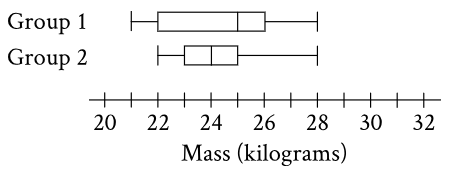
Question: The box plots summarize the masses, in kilograms, of two groups of gazelles. Based on the box plots, which of the following statements must be true?
A) The mean mass of group 1 is greater than the mean mass of group 2.
B) The mean mass of group 1 is less than the mean mass of group 2.
C) The median mass of group 1 is greater than the median mass of group 2.
D) The median mass of group 1 is less than the median mass of group 2.
1️⃣ What This Question Is Testing
This is SAT Data Analysis.
Key idea:
Box plots show medians and quartiles, NOT means.
So:
~ You can compare medians
~ You cannot determine means from a box plot alone
2️⃣ Critical Rules You Must Know
📌 Box Plot Facts
Median → vertical line inside the box
Mean → NOT shown
Statements about means cannot be guaranteed
3️⃣ Read the Box Plots Carefully
From the image:
~ Median of Group 1 is to the right of the median of Group 2
~ That means:
4️⃣ Correct Answer Explained
✅ C) The median mass of group 1 is greater than the median mass of group 2
This is directly visible from the median lines.
5️⃣ Why the Other Options Are Wrong (REAL SAT TRAPS)
❌ A) Mean of group 1 > mean of group 2
❌ B) Mean of group 1 < mean of group 2
→ Means are not shown
→ Distribution shape can change the mean
→ SAT trick: never assume mean from a box plot
❌ D) Median of group 1 < median of group 2
→ Opposite of what the graph clearly shows
🧮 Desmos Note (Why It’s Not Used Here)
Desmos cannot compute medians from box plots unless raw data is given.
This question is visual reasoning, not computation.
16th Question
Question: The function is defined by , where and are integer constants and . The functions and are equivalent to function , where and are constants. Which of the following equations displays the -coordinate of the -intercept of the graph of in the -plane as a constant or coefficient?
I.
II.
A) I only
B) II only
C) I and II
D) Neither I nor II
Understand the Question
The function:
~ where and are constant integer
~ and ( is bigger than value 0 and is bigger than )
The functions and are equivalent to function
~ where and are constants
it means and
The graph of in the -plane
I.
II.
Which equation displays the -coordinate of the -intercept as a constant or coefficient?
🧠 STEP 1: What the question is REALLY testing (critical)
The question is not asking:
~ which form is equivalent or
~ which form gives the y-intercept when substituted
It is asking something much stricter:
~ Does the equation visibly display the y-intercept as a constant or coefficient?
That means:
~ The y-intercept must be directly readable
~ Not hidden inside a parameter
~ Not requiring substitution or calculation
This distinction is where the trap is.
🧠 STEP 2: Find the actual y-intercept of
y-intercept occurs where:
Substitute into :
The exponent 0 means 1:
Nothing (Because of 0, when there is nothing, 1 left alone always)
So the true y-intercept value is:
Keep this exact form in mind — everything is compared to this value.
🧠 STEP 3: Analyze Statement I CAREFULLY
I.
Because is equivalent to , we must have:
Now find the y-intercept of :
Substitute :
✔ This equals the correct y-intercept value.
⚠ BUT HERE IS THE KEY POINT (SAT LOGIC):
~ The equation does NOT show explicitly
~ The y-intercept is hidden inside the symbol
~ You cannot read the y-intercept directly from the equation
~ If the I takes common then it will match exactly the same to the equation but “The question especially emphasis on Display part,” so we cannot choose it.
Since:
is just a placeholder, not the intercept itself
❌ Statement I does NOT display the y-intercept as a constant or coefficient
🧠 STEP 4: Analyze Statement II (same strict logic)
II.
Because is equivalent to , we must have:
Now evaluate the y-intercept:
✔ This equals the correct y-intercept value.
⚠ But again — SAT precision matters:
~ The y-intercept is not shown directly
~ The constant equals only part of the intercept
~ The full intercept is , not just
So:
~ The equation does not explicitly display the y-intercept
~ You must still compute it
❌ Statement II also fails the requirement
🧠 STEP 5: Why “I and II” is WRONG (this is where I earlier erred
The earlier mistake was assuming:
“If substituting x = 0 gives the intercept, then it is displayed.”
That assumption is incorrect for this question.
The phrase “displays the y-coordinate as a constant or coefficient” means:
~ You should be able to see the y-intercept immediately
~ Without substitution
~ Without hidden parameters
~ Without algebra
~ Neither equation does that.
✅ CORRECT ANSWER: Option D
Choice A seems possible but the word “Display” made it incorrect. The question is easy but it is a difficult category question, that means hidden keys. You must practice questions like these, so it won’t hinder your exam score.
Choice B is clearly incorrect, whether we talk about visual or equation, it never matches it
Choice C is also incorrect because II is clearly incorrect.
17th Question
Question: Square A has side lengths that are 166 times the side lengths of square B. The area of square A is times the area of square B. What is the value of ?
A) 2
B) 166
C) 332
D) 27556
✅ Understand the QUESTION — Squares & Area Scaling
Given
~ Side of square A = 166 × side of square B
~ Area of square A = × area of square B
~ Find
1️⃣ Key Rule (VERY IMPORTANT)
📌 Area Scaling Rule
If side length scales by factor ,
2️⃣ Step-by-Step Calculation
Side ratio:
Area ratio:
✅ Correct Answer: Option D
❌ Why Other Options Are Wrong
❌ 2 → ignored scale completely
❌ 166 → linear scaling mistake
❌ 332 → doubled instead of squared
SAT loves squaring traps.
🧮 Desmos Trick (Legit Use)
Type: 166^2
Instant verification.
18th Question
Question: A school district is forming a committee to discuss plans for the construction of a new high school. Of those invited to join the committee, 15% are parents of students, 45% are teachers from the current high school, 25% are school and district administrators, and the remaining 6 individuals are students. How many more teachers were invited to join the committee than school and district administrators?
A) 6
B) 8
C) 10
D) 18
✅ Understand the Question
Committee members:
~ 15% parents
~ 45% teachers
~ 25% administrators
~ Remaining = 6 students
How many more teachers than administrators were invited?
1️⃣ What the Question Is Testing
This is percent → total → comparison.
Key challenge:
The total number is NOT given directly — you must find it.
2️⃣ Step-by-Step Solution
Step 1: Add known percentages
So remaining:
This 15% corresponds to 6 students. Because they are remaining.
Step 2: Find the total number invited
Total invited = 40 people
Step 3: Find teachers and administrators
Teachers:
Administrators:
Step 4: Compare
✅ Correct Answer: Option B
8 more teachers.
❌ Incorrect Options Explained
❌ 6 → forgot to convert percent to total
❌ 10 → confused administrators count with difference
❌ 18 → gave number of teachers, not the difference
🧮 Desmos Trick (REAL USE)
1. Calculate all percentage:
~ Type: 100 – (15 + 45 +25)
~ Output: 15
That is out 15% which is equal to 6 students.
2. Type: 6 * 100/15
→ gives 40
3. Then use teacher and administers percentage:
45 * 40/100
0.25 * 40/100
4. The output will be: 18 and 10
5. Find how many teachers are more than administers: 18 – 10
6. Output: 8
Fast and SAT-legal.
19th Question
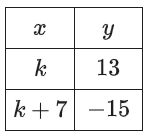
Question: The table gives the coordinates of two points on a line in the -plane. The -intercept of the line is , where and are constants. What is the value of ?
[Type-Based Answer: In the final exam, you will type the answer rather than choose from options.]
✅ Correct Answer:
🧮 Correct Solution — Step by Step
Step 1: Identify the two given points
From the table:
Point 1 (x1, y1):
Point 2 (x2, y2):
Step 2: Find the slope of the line
Slope formula:
Substitute:
✔ Slope is −4
Step 3: Use slope to find the y-intercept
Use point-slope reasoning with point . Instead of using Point 1, you can also use Point 2.
Slope-intercept form:
Substitute values:
Solve for :
Step 4: Use the given y-intercept coordinate
The y-intercept is given as:
But y-intercept always has x = 0.
So:
Step 5: Substitute into
✔ Correct value of is 33.
Trap 1: b = 13 ❌
How students get this:
They think: “The y-intercept must be one of the given y-values.”
But neither given point is at x = 0.
❌ Incorrect logic
Clarification
First, what is a y-intercept? (This matters for Step 4)
A y-intercept is: The point where the graph crosses the y-axis
This is not optional, not a formula trick — it is a definition.
CRITICAL FACT
On the y-axis, the x-coordinate is always 0.
Why?
Because:
~ The y-axis is the vertical line where x does not move left or right.
~ Any point on the y-axis has x = 0.
Examples:
~ (0, 5) → on the y-axis
~ (0, −3) → on the y-axis
~ (0, b) → y-intercept in general
If x ≠ 0, the point is not on the y-axis.
🧮 DESMOS CALCULATOR — CLEAN & FAST METHOD
Step-by-Step in Desmos
1. Open Desmos
2. Define points:
~ A = (5, 13)
~ B = (12, -15)
3. Type: y = -4x + b
4. Adjust b slider until the line passes through both points
5. Desmos shows: b = 33
✔ Visual confirmation
20th Question
Question: If for all positive values of , what is the value of ?
[Type-Based Answer: In the final exam, you will type the answer rather than choose from options.]
1️⃣ First: What is this “3”? Is it multiplied, divided, or something else?
That small 3 is NOT multiplication.
It is the index of the radical, meaning:
🔹 Rule
So:
• Square root (a normal root like this ) → index or is 2
• Cube root (a cube root like this ) → index or is 3
2️⃣ Why Do We Use or ?
Because radicals and exponents are equivalent forms.
Fundamental Identity:
That’s why:
• Square root → power
• Cube root → power
3️⃣ Step-by-Step Solution
Rewrite Each Part Using Exponents
Numerator
Explanation:
• Square root = power
• So exponent becomes
Denominator
Explanation:
• Cube root = power
• So exponent becomes
4️⃣ Divide Powers with the Same Base
We now have:
Rule:
What Divide is actually: We subtract values in divide, right?
So:
Step-by-Step Subtraction
Convert to a common denominator:
Take LCM of denominator 2 and 3:
It is 6.
Now divide New LCM Denominator by Old denominators:
Multiply the value to its numerator:
Subtract:
5️⃣ Final Exponent
So:
✅ FINAL ANSWER: or
⚠️ COMMON STUDENT MISTAKES (VERY IMPORTANT)
❌ Mistake 1: Treating the 3 as multiplication
Students think:
❌ Completely wrong
❌ Mistake 2: Writing
Wrong — index controls denominator
❌ Mistake 3: Dividing exponents instead of subtracting
They do:❌ Illegal operation
❌ Mistake 4: Forgetting common denominator
Leads to wrong fraction like
🧮 REAL DESMOS CHECK
You must know basic concepts. All the Hard questions requires your Mathematical knowledge. You should use Desmos only as a calculator.
21th Question
Question: A sample of 40 fourth-grade students was selected at random from a certain school. The 40 students completed a survey about the morning announcements, and 32 thought the announcements were helpful. Which of the following is the largest population to which the results of the survey can be applied?
A) The 40 students who were surveyed
B) All fourth-grade students at the school
C) All students at the school
D) All fourth-grade students in the county in which the school is located
1️⃣ What This Question Is Testing
~ sample of 40 fourth-grade students
~ sample from one school
~ largest population
This is statistical inference.
Key SAT rule:
You can generalize results only to the population from which the sample was randomly selected.
2️⃣ Identify the Population
~ Sample: 40 fourth-graders
~ Location: one school
~ Random selection: within that school only
3️⃣ Correct Answer Explained
✅ B) All fourth-grade students at the school
Why?
~ Same grade
~ Same school
~ Same population source
4️⃣ Why Other Options Are Wrong
❌ A) Only the 40 students
→ Too narrow, 40 students of what / where (SAT wants the largest valid population)
❌ C) All students at the school
→ Includes other grades → not sampled
❌ D) All fourth-graders in the county
→ Different schools → not randomly sampled
🧮 Desmos Note
Desmos is not used here because:
~ No calculation required
~ This is a logic + sampling question
22th Question
Question: Function is defined by , where and are constants. In the -plane, the graph of has a -intercept at . The product of and is . What is the value of ?
[Type-Based Answer: In the final exam, you will type the answer rather than choose from options.]
✅ Understand the QUESTION
Question
The graph of:
has a y-intercept at:
Given:
Find .
1️⃣ Key Concept
The y-intercept occurs when:
2️⃣ Step-by-Step Solution
Rather then first solving for then put the value of into the graph of y. It would be better that we directly put into the equation like below:
Compute the y-Intercept Algebraically
Start with:
Substitute :
Since:
Nothing, so it leaves with 1 only.
Put the value of 1 in the equation:
3️⃣ Use the Given y-Intercept:
Put the value of y-intercept now
Add 13 to both sides or just move -13 to right-hand side:
Let’s see both ways for educational purpose:
| Add 13 to both sides | Move -13 to Right-hand side |
|---|---|
4️⃣ Use the Product Condition
We have b now and we need to find a
Substitute :
Multiply both sides by 7:
✅ Correct Answer: 20
❌ Typical Traps
• Forgetting to subtract 12
• Using instead of 1
• Mixing up intercept with asymptote
🧮 Desmos Confirmation
Use Desmos only for calculator, above you are given all steps, just understand them and crack it up.
Did you try all the features and get comfortable using them? You should work on using the calculator and seeing references and directions. So be prepared for everything before taking the final SAT exam. The explanation of answers makes easier to learn and progress. You must try to work on your speed and spend less time on the beginning and more on the later questions. This is the SAT 2024 Practice Test of Math Module 2nd.
There are more tests available:
- SAT 2025 Test (Math Module 1st)
- SAT Test 3rd (Math Module 1st)
- SAT Test 6th (Reading and Writing Module 2nd)
The best way to become a master in Math is to find the correct answer and understand why other options are incorrect. I wish you luck in your bright career.